Reading Comprehension in India: A Practical Guide for Parents
A child can be enrolled in school, attend every day, sit for every exam, and still not be able to read a simple paragraph meant for a class two years below theirs. That gap, between being in school and actually learning, is one of the most consistent findings in Indian education data, and it’s exactly what reading comprehension assessments are built to catch.
Enrolment numbers tell you how many children are in the system. They don’t tell you whether the system is teaching them to read and understand what they read, which is arguably the single most foundational skill a child needs before any other subject makes sense. This is where ASER, the Annual Status of Education Report published by Pratham, becomes one of the most useful data sources available. It’s a household survey, not a school-reported statistic, which means it captures what children can actually do, not just what schools report.
This piece uses the latest available data, the ASER 2024 full report, released in January 2025, alongside NCERT’s PARAKH Rashtriya Sarvekshan 2024, a newer school-based assessment whose results were published in 2025, to answer a fairly direct question: how many Indian children actually read at grade level, and what does that number mean for a parent trying to make sense of it?
What Is Reading Comprehension?
Reading comprehension is often confused with more basic reading skills, but they’re not the same thing. There’s a progression involved:
Recognising letters and words is the starting point, a child can sound out a word without necessarily knowing what it means. Reading a passage fluently is the next step, moving through text at a reasonable pace without stumbling over every word. Reading comprehension goes further still: it’s the ability to understand what a passage is actually saying, follow its meaning, and answer a question about it correctly. Beyond that sits application, using what was read to interpret new information or solve a problem.
A child can technically “read” a passage aloud, word by word, without comprehending a single sentence of it. This distinction matters because reading skills assessments that only test word recognition can make a classroom look more capable than it actually is, and it’s precisely why foundational literacy sits at the centre of NEP 2020’s early-grade priorities.
How Is Reading Ability Measured in India?
The ASER 2024 full report is a nationwide household survey conducted by the Pratham Foundation, running annually since 2005 and now, since 2016, in a full national round every alternate year. Unlike a school-reported statistic, ASER surveys reach children directly at home, testing reading and arithmetic one-on-one, regardless of what grade the child is officially enrolled in. The ASER 2024 round reached roughly 6.5 lakh children across more than 17,000 villages in over 600 rural districts, making it one of the largest citizen-led education surveys anywhere in the world.
This is why ASER matters for a picture that enrolment data alone can’t provide, and why it remains one of the most cited education statistics sources on student learning outcomes in India. Over 90% of children aged 6 to 14 are enrolled in school in rural India, per the ASER 2024 report, a number that’s looked strong for over a decade now. But being enrolled has never been the hard part of Indian education. Whether a child sitting in a classroom is actually acquiring reading skills at the expected pace is a completely separate question, and it’s the one ASER, and more recently NCERT’s PARAKH assessment body set up under the National Education Policy (NEP) 2020, are specifically designed to answer.
Reading Skills in India: How Many Children Read at Grade Level?
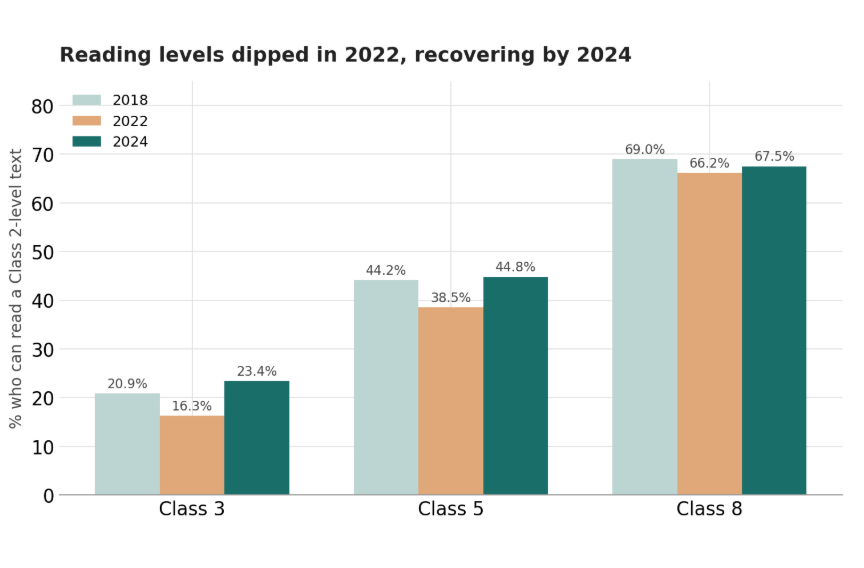
This is the core question, and the ASER 2024 full report gives a fairly precise answer, using a consistent benchmark: whether a child can read a Class 2-level text, regardless of what grade they’re actually in.
(Source: ASER 2024. Figures represent the respective reporting periods and are not live data. Historical figures are included where available to show trends over time.)
A few things stand out here. First, the grade 3 reading level: fewer than one in four children in Class 3 can read text meant for a child two grades younger. That’s the highest Class 3 figure ASER has recorded since it began tracking this in 2005, which sounds like good news, and relative to the pandemic-era low of 16.3% in 2022, it is. But it also means roughly three in four Class 3 children in rural India still can’t comfortably read at that basic benchmark.
Second, the recovery pattern. All three grades dipped in 2022, the aftermath of prolonged pandemic school closures, and all three have recovered by 2024. The grade 5 reading level has essentially returned to its 2018 mark. Class 3 has gone slightly past it. Class 8 hasn’t quite recovered to where it stood in 2018, sitting about a percentage and a half below.
Third, and this is easy to miss: by Class 8, roughly a third of students still can’t read a Class 2-level passage. That’s not a Class 3 problem that resolves itself with time. Without intervention, reading gaps that start early tend to persist through a child’s schooling.
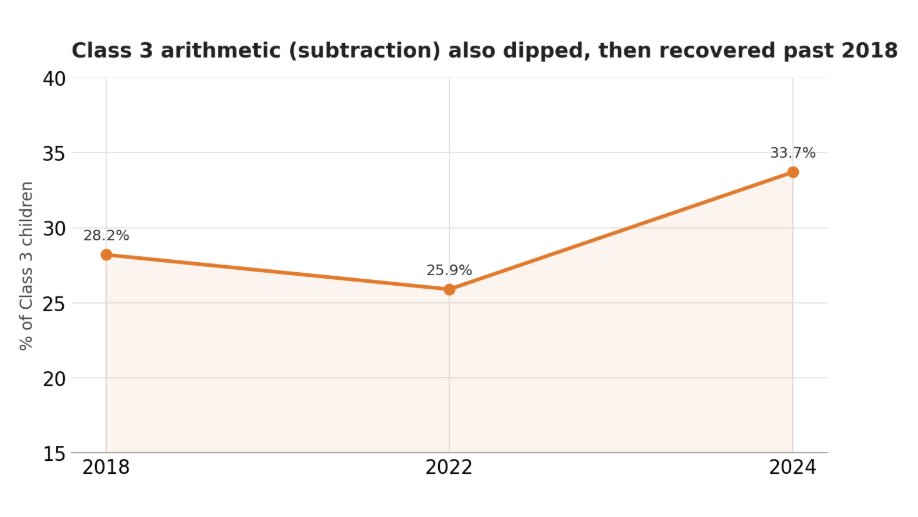
Arithmetic follows a similar arc.
(Source: ASER 2024. Figures represent the respective reporting periods and are not live data. Historical figures are included where available to show trends over time.)
In Class 3, the share of children who could solve a basic subtraction problem rose to 33.7% in 2024, up from 25.9% in 2022, and above the 28.2% recorded in 2018. Government schools drove most of this recovery, in both reading and arithmetic, outpacing the improvement seen in private schools over the same period, according to the ASER 2024 findings.
Reading Skills and Rural Education in India
Since ASER surveys rural households specifically, the data offers an unusually detailed picture of rural learning outcomes, one that’s easy to misread if you’re not careful about what it does and doesn’t say.
Enrolment in rural India is not the problem. Over 90% of children aged 6-14 are in school, per the ASER 2024 report, and that figure has held steady for years. What varies significantly is what happens after that: whether a child in a rural government school in one state is progressing at a similar pace to a child in another state, or in an urban private school.
State-level results in ASER 2024 show real variation. States like Gujarat, Uttar Pradesh, Uttarakhand, and Sikkim recorded double-digit improvements in reading levels, while a handful of states, including Punjab, Andhra Pradesh, and Telangana, saw declines over the same period. This is worth sitting with: rural education in India isn’t one uniform story. A rural classroom in a state with strong foundational learning programmes can outperform an urban one in a state where those programmes are weaker, and vice versa.
The honest takeaway is that “rural” and “urban” are far too broad to predict learning outcomes on their own. Rural education statistics at the state level matter more than the rural-urban label itself, and rural children’s education outcomes vary as much within states as they do between them.
Reading Ability vs Literacy Rate in India
This is a distinction worth being precise about, because the two numbers get used interchangeably in conversation far too often.
India’s literacy rate, the headline figure behind most “literacy rate India” searches, per the Periodic Labour Force Survey (PLFS) 2023-24, as confirmed by the Ministry of Education, stands at 80.9%, up from 74% recorded in the 2011 Census, still India’s most recent full Census, since the next one has been delayed. That’s a measure of whether a person aged seven and above can read and write with basic understanding, self-reported or assessed at a fairly minimal threshold, across the entire population, adults included. It’s the standard measure of literacy in India used for broad national and international comparisons, but it isn’t designed to say anything about a specific child’s reading proficiency at a specific grade.
Grade-level reading ability, the kind ASER measures, is a completely different instrument. It tests whether a specific child, at a specific grade, can read and comprehend a text considered appropriate for a child two or more years younger. It’s a much stricter, much more specific benchmark of child literacy, applied only to school-age children, not the adult population as a whole.
This is why a headline literacy rate climbing past 80% and an ASER finding that fewer than one in four Class 3 children can read a Class 2-level text are not contradictory. They’re measuring different things entirely: one is a broad population-level indicator of basic reading and writing ability, the other is a grade-specific test of reading comprehension against a defined benchmark. A rising national literacy rate doesn’t tell you whether today’s schoolchildren are developing reading comprehension skills fast enough at the grade levels where it matters most.
Student Learning Outcomes in India: What the Latest Data Shows
ASER 2024 isn’t the only recent measure of this. In December 2024, NCERT’s assessment body PARAKH ran its Rashtriya Sarvekshan 2024, a school-based national learning assessment covering government, aided, and private schools across both rural and urban India, with results published in mid-2025, making it the most recently released large-scale learning dataset available. It’s a different instrument from ASER: school-based rather than household-based, and national rather than rural-only, but it points in a similar direction on reading specifically.
(Source: PARAKH Rashtriya Sarvekshan 2024, NCERT. Figures represent the respective assessment cycles and are not live data.)
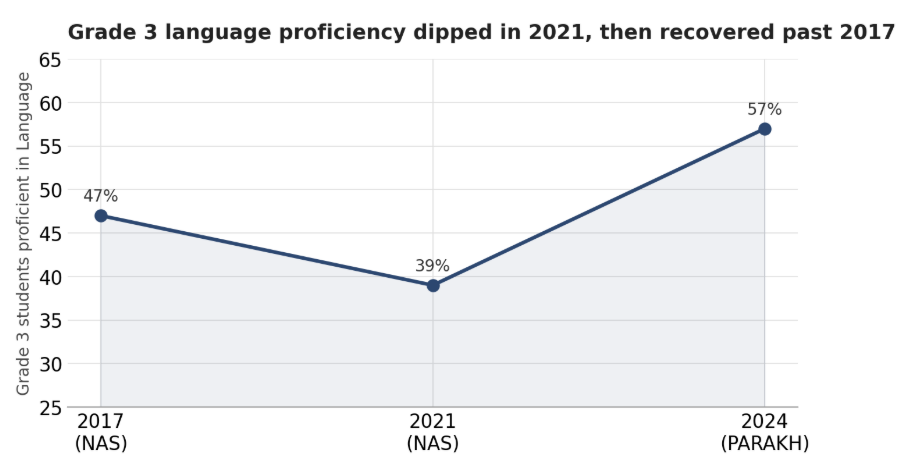
Within the Language competency, PARAKH found reading comprehension was the weakest sub-skill nationally, scoring 60%, against 67% for using language in everyday interactions. Grade 3 proficiency in Language recovered to 57% in 2024, up sharply from 39% in 2021 and above the 47% recorded in 2017, broadly consistent with the recovery pattern ASER found in its own, separately-run rural survey. Two different methodologies landing on the same direction, recovery from a pandemic dip, but not yet a fully closed gap, is a stronger signal than either dataset alone.
Put together, the ASER 2024 full report and PARAKH findings describe a recovery that’s real but incomplete, and add up to some of the most important Indian education statistics available on foundational learning today. Reading and arithmetic levels across Class 3, 5, and 8 have bounced back from the pandemic-era low recorded in 2022, in some cases surpassing 2018 levels. That recovery has been driven disproportionately by government schools, which improved faster than private schools across most of the grades and skills ASER tracks.
But recovery from a dip is not the same as the system reaching where it needs to be. Even at the improved 2024 levels, a majority of Class 3 children, and a meaningful share of Class 8 children, still fall short of grade-appropriate reading comprehension. The gains are genuine. The gap they’re closing is still large. This lines up with the global picture too: the World Bank’s India Learning Poverty Brief put 56% of Indian children at late-primary age as unable to read and understand a short, age-appropriate text, using its own distinct international benchmark, a different methodology from both ASER and PARAKH, but directionally telling the same story.
State-level variation adds another layer: national averages smooth over what are, in practice, very different learning trajectories depending on where a child happens to go to school. A single national percentage is useful for tracking direction over time, but it says very little about any individual child’s classroom.
Why Reading Comprehension Skills Matter Beyond School
Reading comprehension isn’t a standalone subject, it’s the skill nearly every other subject depends on. A child who struggles to comprehend a passage will struggle with a word problem in mathematics, a diagram-based question in science, or a comprehension passage in a language exam, not because they don’t understand the subject, but because they can’t reliably extract meaning from the text in front of them.
It also shapes how independently a child can learn. A student with strong reading comprehension can pick up a textbook chapter and make sense of it without needing every concept explained aloud. A student without that skill remains dependent on direct instruction for far longer, which becomes a bigger constraint as content gets more complex through middle and secondary school. Comprehension also affects something more immediate: a child’s ability to understand instructions, whether that’s a worksheet, an exam question, or directions for an activity, which shapes how confidently they navigate a classroom day to day.
What India’s Education Statistics Mean for Parents
National data like this is genuinely useful, but it has a clear limit: it can tell you what’s happening across India or across a state, not whether a specific school is teaching your specific child to read well. Two schools in the same city, sometimes the same neighbourhood, can produce very different reading outcomes depending on their teaching approach, class sizes, and how seriously foundational literacy is prioritised in the early grades.
That’s the gap national statistics can’t close, and it’s the reason school-level evaluation matters as much as national trends. When you’re comparing schools, it’s worth looking past board affiliation and fee structure to the things that actually shape reading and learning outcomes: how the school approaches foundational literacy in the early years, what its teaching methodology looks like beyond rote instruction, class sizes and the student-teacher environment, and whether the school can speak concretely to how it tracks each child’s learning progress rather than just exam results.
This is exactly the kind of comparison BodhaNow is built for, moving from a national number to a specific decision about a specific child. Search for schools, compare them side by side on the factors that actually affect learning, and decide with more than a brand name to go on.
Reading ability is only one part of India’s broader education landscape. Our India’s Education System in 10 Numbers guide brings together key statistics on schools, students, teachers, infrastructure and learning.
Find the Right School for Your Child
Explore CBSE, ICSE & IB schools in Bangalore. Check real-time ratings, dynamic GPS coordinates, and complete fee charts instantly.