How to Improve Handwriting in Children: Exercises That Actually Help
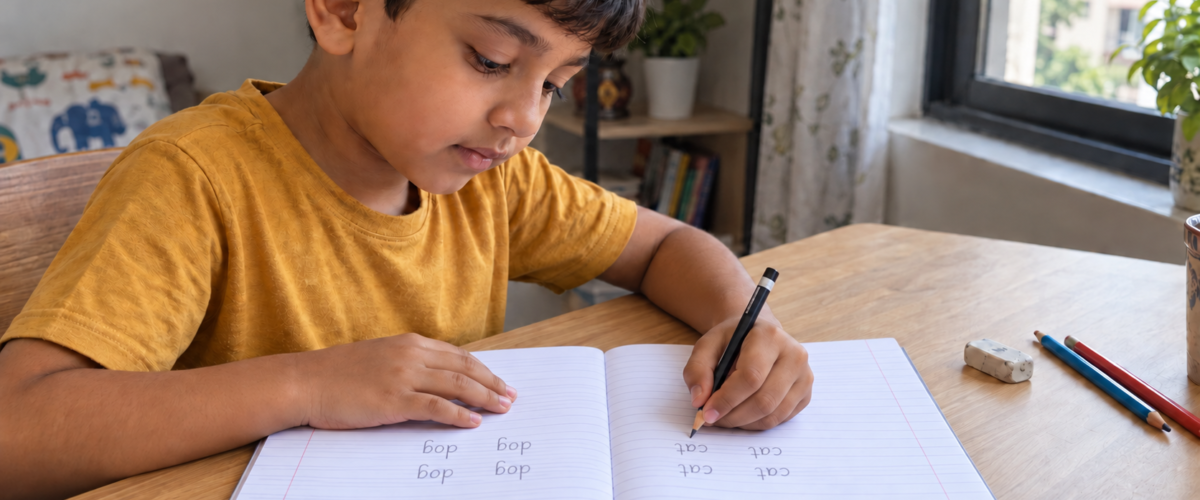
If you are wondering how to improve handwriting, start with the part your child finds difficult: forming letters, leaving spaces, staying on the line or writing comfortably. A few focused attempts at one skill give practice a clearer purpose than another page of copying.
Help children write more clearly by demonstrating letter movements, practising a small number of letters, working on spacing and using comfortable seating and writing tools. Keep sessions brief, follow the school’s letter style and build towards meaningful words and sentences. Pause if writing hurts. Persistent pain, fatigue or difficulty keeping up deserves a conversation with the teacher and, where needed, a qualified professional.
Choose formation, spacing or size for today. Avoid correcting everything together.
A five-to-ten-minute session can be a starting point. Shorten it when needed.
The aim is readable writing that lets your child put ideas on paper without pain.
Why “Write Neatly” Does Not Tell a Child What to Change
Your child brings home a notebook with crowded words and letters of different sizes. You ask them to write the page again. The second attempt looks much like the first, except now they are upset.
The instruction describes the result you want but leaves the method unexplained. Does the child know where each letter begins? Can they see where one word ends? Are they rushing because copying takes too long?
Watch them write a familiar word and one short sentence. Compare that with ordinary classwork. Neat copying alongside difficult independent writing may mean that spelling, remembering instructions or organising ideas adds to the workload. Ask the teacher what they notice.
How to Improve Handwriting: Get the Setup Right
Before opening a workbook, check whether the child can sit comfortably with their feet supported and forearms resting on the table. A stable footrest may help when their feet do not reach the floor. Let the other hand steady the page.
Ask whether the pencil feels comfortable. A thicker pencil or a grip may help some children, but buying a particular product is not the starting requirement. East Cheshire NHS guidance notes that an adapted grasp can be acceptable when it is comfortable and functional.
Parents asking how to improve handwriting often begin with the pencil grip. Also check the task: a child still learning letter shapes needs different practice from one who forms letters confidently but leaves no spaces.
Six Handwriting Exercises to Try at Home
The useful question is how to improve handwriting through practice that matches the problem. Choose one exercise below rather than completing all six in a sitting. Open each panel for the steps and an example.
Watch, copy, cover and write
Useful for: a child who is unsure how to form a letter.
Demonstrate one letter slowly using the school’s starting point and direction. Let the child copy it, then cover the example and ask them to try from memory. Uncover it together and discuss one feature they can recognise.
Tracing can introduce a movement, but include attempts without a dotted outline. The goal is to make the letter independently, not only follow a path.
Practise letters with related movements
Useful for: inconsistent starting points and letter shapes.
Choose a small group that shares a movement in the school’s handwriting scheme. In many print styles, c, o and a share a curved movement. Demonstrate each separately before asking the child to use them in words.
For a beginner, one letter may be enough. Move on when the movement is becoming familiar, rather than filling a whole page.
Give each word some breathing room
Useful for: words that run together.
Say a short sentence aloud and identify its separate words. Write it using a small card spacer or a finger space as a temporary guide. Afterwards, ask the child to point to each word as they read it back.
Explain that the larger gaps belong between words, not between every letter. Gradually try without the spacer.
Use a baseline and letter-height guides
Useful for: floating letters and uneven size.
Highlight the baseline on suitable handwriting paper. Show where a short letter sits, where a tall letter reaches and where a descending letter goes below the line. Follow the school’s examples.
Choose line spacing that suits the child’s current writing size. Do not make a beginner squeeze large, developing letters into tiny ruled spaces.
Explore lighter and darker pencil marks
Useful for: noticing how much pressure the child uses.
Invite the child to shade a small patch lightly and another a little darker, staying comfortable. Then write one familiar word with enough pressure to make it easy to read.
This is an awareness activity, not a strength test. Stop if the hand hurts; repeated pain or deep indentations deserve a closer look at comfort, tools and technique.
Write something someone will actually read
Useful for: taking a practised skill beyond the worksheet.
Let the child make a snack list, label a drawing or write a short message. Keep the purpose real and choose one handwriting target for that attempt.
Read the message and respond to its meaning before discussing presentation. The child should experience writing as communication, not a constant neatness test.
A Short Routine for Handwriting Practice for Kids
Choose a time when the child is reasonably rested. The outline below is a flexible example, not a prescribed treatment or a promise of improvement within a set number of days.
| Part of the session | What to do |
|---|---|
| Settle in | Check seating, paper position and pencil comfort. Choose one target. |
| Demonstrate | Show the movement or spacing once, using the teacher’s cues. |
| Practise briefly | Try a few letters or words. Pause before fatigue takes over. |
| Use and review | Write a short message. Let the child choose one improvement they can see. |
Keep a dated sample occasionally. Look for clearer spaces, fewer prompts or greater comfort, rather than expecting every new page to look better. A tired evening is not proof that progress has disappeared.
What About Younger and Left-Handed Children?
Children still learning to make marks can explore lines, circles, drawing and large movements before tackling small letters. Play with dough or building materials can give opportunities to use the hands, but it should not replace direct letter teaching when a child is ready to write.
Let a left-handed child use their preferred hand. Position the paper slightly to the left and adjust its angle so they can see their work comfortably. Place a model above the writing area where their hand will not cover it. Leave elbow room beside a right-handed classmate or sibling.
A left-handed child may find holding the pencil slightly farther from the tip helpful. Try adjustments gently; the aim is a clear view and comfortable movement, not forcing a pose.
Help Without Turning Practice Into a Battle
“These two words have clear spaces” gives useful feedback. “Your sister writes better” gives a comparison the child cannot act on. Agree on today’s target before starting, and leave unrelated errors for another time.
- Offer a choice of a short message, label or list.
- Correct a small example instead of demanding a whole-page rewrite.
- Build readable, comfortable writing before adding speed pressure.
- Keep practice separate from punishment or lost playtime.
When Does a Child Need Additional Academic Support?
If your child needs additional one-to-one academic support, choosing a tutor who understands their learning needs and current level can make the support more effective. Read our guide on how to choose the right tutor before getting started.
If you have been working on how to improve handwriting and your child remains uncomfortable or cannot complete classroom tasks, discuss it with the teacher. Bring a practice sample and a piece of everyday work so the conversation includes both.
- Repeated pain, cramping or marked fatigue during writing.
- Writing difficulties that regularly prevent the child from showing what they know.
- Persistent distress or little progress despite suitable teaching and practice.
A paediatrician or paediatric occupational therapist can help assess persistent physical or developmental concerns. Handwriting alone cannot establish a diagnosis. Academic support may also involve teaching adjustments or agreed alternatives for longer answers while handwriting develops.
If your child needs additional academic support alongside handwriting practice, the right tutor can provide more personalised guidance based on their grade and learning needs. Explore our class-wise online tutor guide to understand what to look for at different stages.
Your Practice Checklist
Tick these as you prepare. This checklist is for this visit and does not save your selections.
Frequently Asked Questions
How long should a child practise each day?
Some NHS occupational therapy guidance suggests five to ten minutes of targeted practice. Treat that as a starting point, not a quota. Age, readiness, comfort and any individual advice should guide the session.
Is cursive better than print?
Follow the style taught at school and discuss adaptations if it is difficult. The practical goals are legibility, comfort and useful fluency. Adding joins will not automatically solve unclear letter shapes.
Will tracing worksheets solve the problem?
Tracing can introduce a path, but children also need to make the movement independently. Include opportunities to write without tracing and use the letter in a word.
Should I buy a special handwriting workbook?
Ask the teacher first. Useful handwriting practice for kids should match their current skill and classroom letter style. A notebook and a clear model may be enough to begin.
Conclusion: Make the Next Attempt Easier
Understanding how to improve handwriting starts with noticing what gets in the child’s way. Choose one difficulty, demonstrate one change and give them a manageable chance to try it. A readable sentence written comfortably is a worthwhile achievement.
Sources and further reading
These occupational therapy resources inform the guidance above. The home examples are illustrative and should be adapted with the child’s teacher.
- Bedfordshire and Luton Children’s Health: handwriting and typing
- Oxford Health: handwriting comfort, size and spacing
- East Cheshire: children’s occupational therapy and pencil grasp
- CPFT: occupational therapy toolkit
- Chesterfield Royal Hospital: practising one skill at a time
- Evelina London: school-age occupational therapy resource pack (PDF)
- Cambridgeshire and Peterborough: Ready to Learn pack (PDF)
Find the Right School for Your Child
Explore CBSE, ICSE & IB schools in Bangalore. Check real-time ratings, dynamic GPS coordinates, and complete fee charts instantly.