Technology in Education in India: What the Data Says About AI, Coding and Future Skills
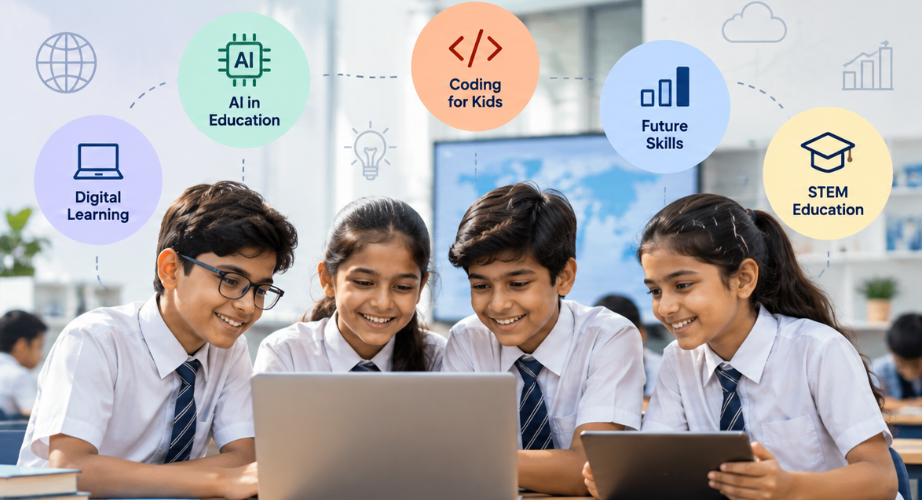
Technology in education has stopped being an optional extra in India. From the 2026-27 academic year, computational thinking and AI are set to start in Class 3 under the curriculum introduced for Classes III to VIII. Coding activities are part of the middle-stage approach under NEP 2020, and the Centre has sanctioned close to 1.8 lakh ICT labs and 1.8 lakh smart classrooms for government schools.
How ready are schools and children for AI in education, coding for kids and future skills? This guide examines official numbers from UDISE+, ASER 2024, the Ministry of Education, NITI Aayog, UNESCO and the OECD to understand school infrastructure, digital literacy and the role of technology in learning.
The numbers show progress, but also gaps in access, teacher training and evidence of learning outcomes. Together, they help explain which 21st-century skills schools are beginning to build and where more work is needed.
What Is Educational Technology?
Educational technology is the use of digital tools, including devices, internet connectivity, software and online platforms, to teach and learn. In Indian schools, this can mean computer labs and smart classrooms, as well as DIKSHA, the national platform for school e-content, and PM eVidya, launched on 17 May 2020 to bring digital, online and broadcast education together.
AI is also becoming part of the discussion. NEP 2020 identifies AI among contemporary subjects schools should introduce and calls for coding activities in the Middle Stage, which covers Classes 6 to 8.
Official data measures infrastructure, such as whether a school has computers and internet access, more consistently than it measures how often students use these facilities or whether they improve learning outcomes. This distinction matters when evaluating the impact of EdTech in India.
School Computer and Internet Statistics in India
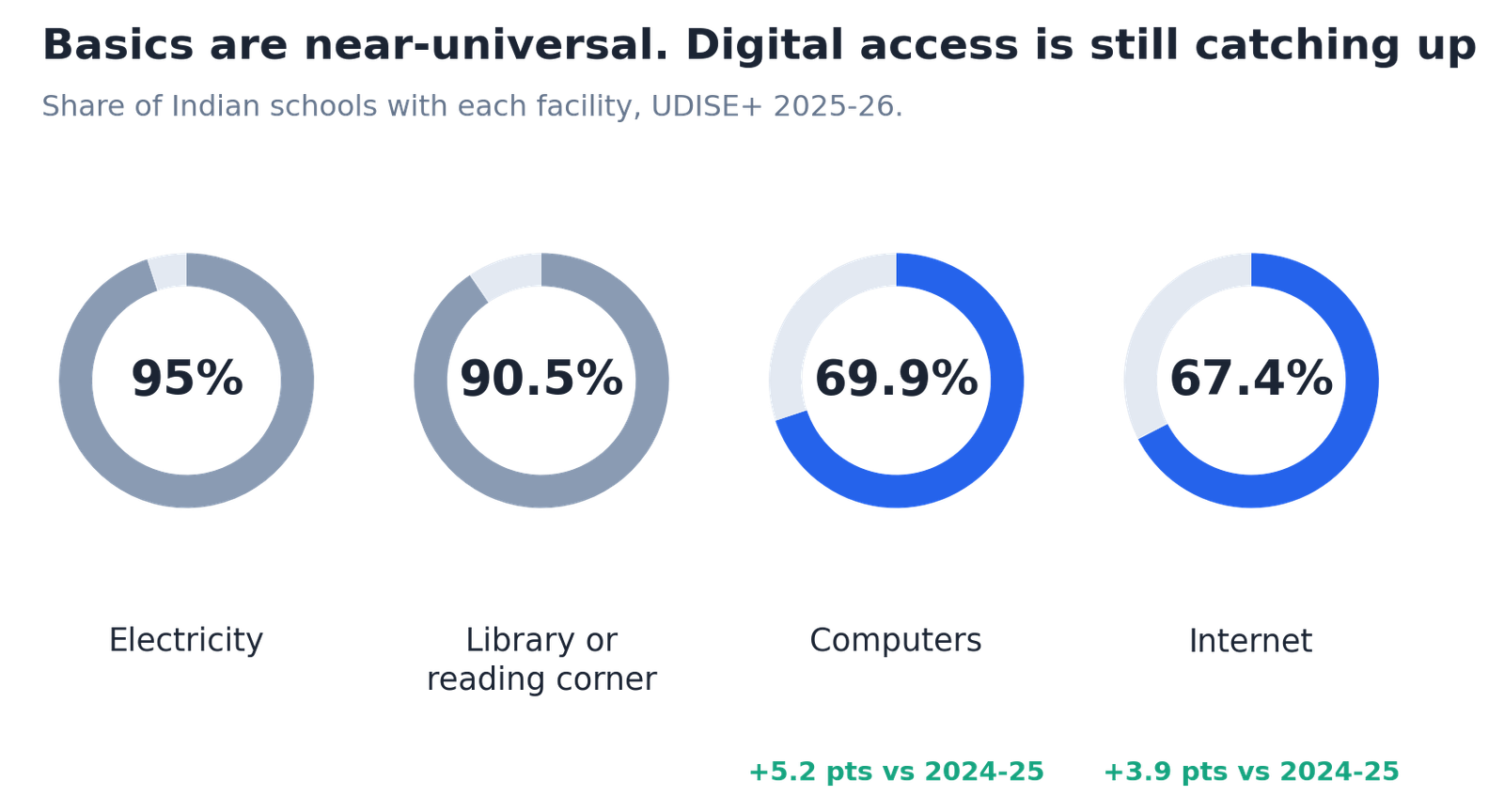
UDISE+ data for 2025-26 reports computer facilities in 69.9% of schools and internet access in 67.4%. In 2024-25, the corresponding figures were 64.7% and 63.5%. Electricity reaches 95% of schools, while 90.5% have a library or reading corner.
| School facility | 2025-26 | 2024-25 |
|---|---|---|
| Computer facilities | 69.9% | 64.7% |
| Internet access | 67.4% | 63.5% |
| Electricity | 95% | Not specified |
| Library or reading corner | 90.5% | Not specified |
Source: UDISE+ 2025-26 and 2024-25, Ministry of Education. Figures refer to their respective reporting periods and are not live data.
About one in three schools still lacks internet access. UDISE+ records whether a facility exists, not how frequently students use it. A school may therefore be counted as connected even if technology is not part of everyday classroom teaching.
UNESCO’s 2023 report found that internet connectivity in India varied by school type: 53% of private unaided schools and 44% of private aided schools were connected, compared with 14% of government schools in the data cited. These older figures should not be treated as current estimates.
For a broader picture, read our guide to education statistics in India and our comparison of government and private schools in India.
Sources: UDISE+ | UNESCO Global Education Monitoring Report
Smart Classroom Statistics in India
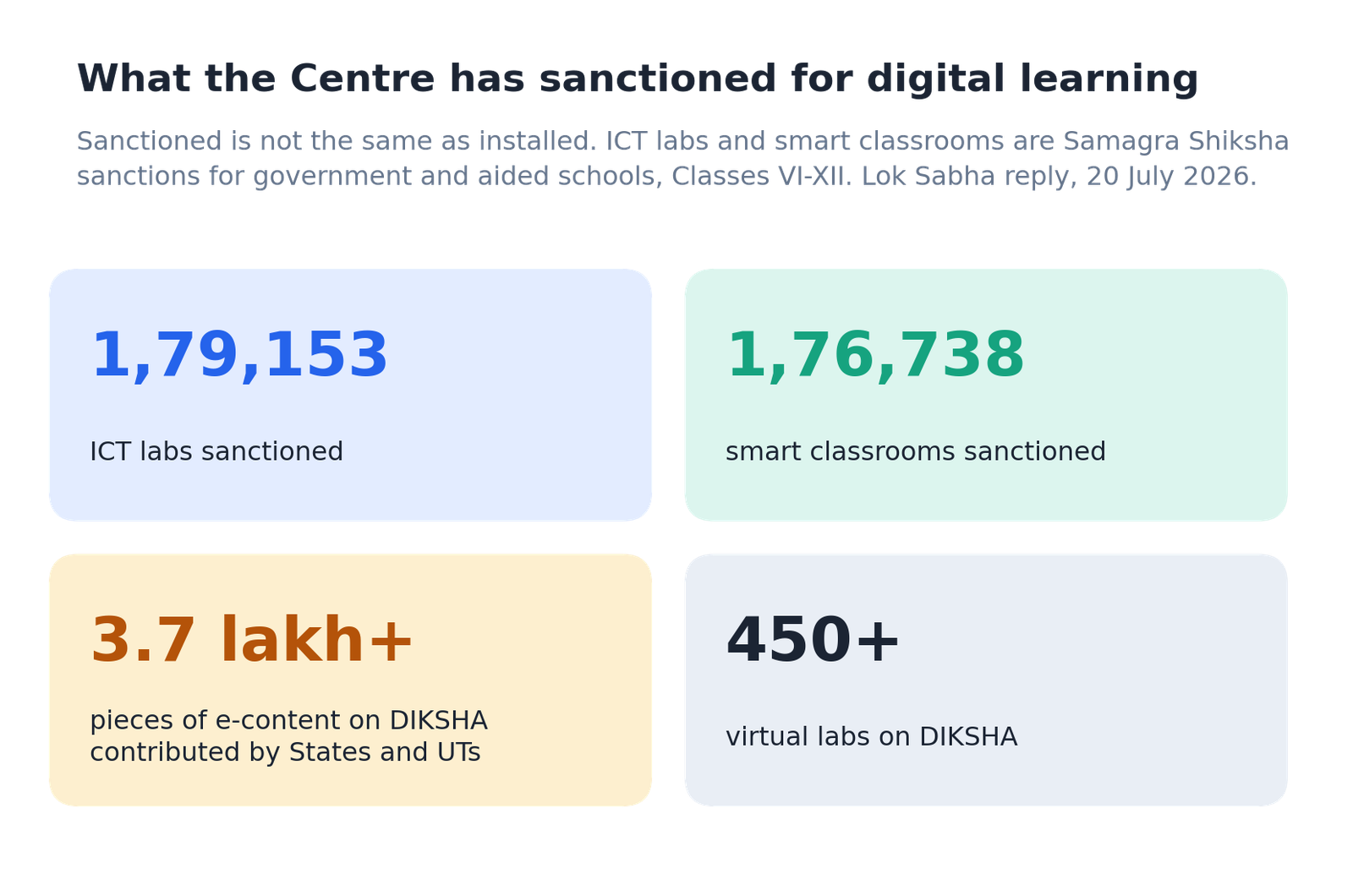
Under Samagra Shiksha, the Centre reported on 20 July 2026 that 1,79,153 ICT labs and 1,76,738 smart classrooms had been sanctioned to States and Union Territories for government and government-aided schools serving Classes VI to XII. For 2025-26 alone, 22,618 ICT labs and 29,920 smart classrooms were approved.
| Infrastructure | Total sanctioned | Approved in 2025-26 |
|---|---|---|
| ICT labs | 1,79,153 | 22,618 |
| Smart classrooms | 1,76,738 | 29,920 |
Source: Ministry of Education, Lok Sabha Unstarred Question No. 29, answered 20 July 2026. Figures are not live data.
Sanctioned does not necessarily mean installed or operational. The same reply refers to the plan to extend broadband to rural government secondary schools under BharatNet, an offline mode for DIKSHA and more than 3.7 lakh pieces of content contributed by States and Union Territories, alongside more than 450 virtual labs.
These EdTech statistics in India demonstrate the scale of planned public investment. They do not establish how frequently students use the facilities or whether the infrastructure has improved learning outcomes.
Source: Ministry of Education
Student Internet Access in India
ASER 2024 introduced a digital literacy section covering rural children aged 14 to 16. Almost 90% lived in a household with a smartphone, and 82.2% reported knowing how to use one. Among those who could use a smartphone, 57% had used it for an educational activity in the previous week, while 76% had used it for social media.
| Digital access indicator | Finding |
|---|---|
| Children living in households with a smartphone | Almost 90% |
| Children who knew how to use a smartphone | 82.2% |
| Smartphone users who used it for education in the previous week | 57% |
| Smartphone users who used it for social media in the previous week | 76% |
| Boys reporting ownership of their own smartphone | 36.2% |
| Girls reporting ownership of their own smartphone | 26.9% |
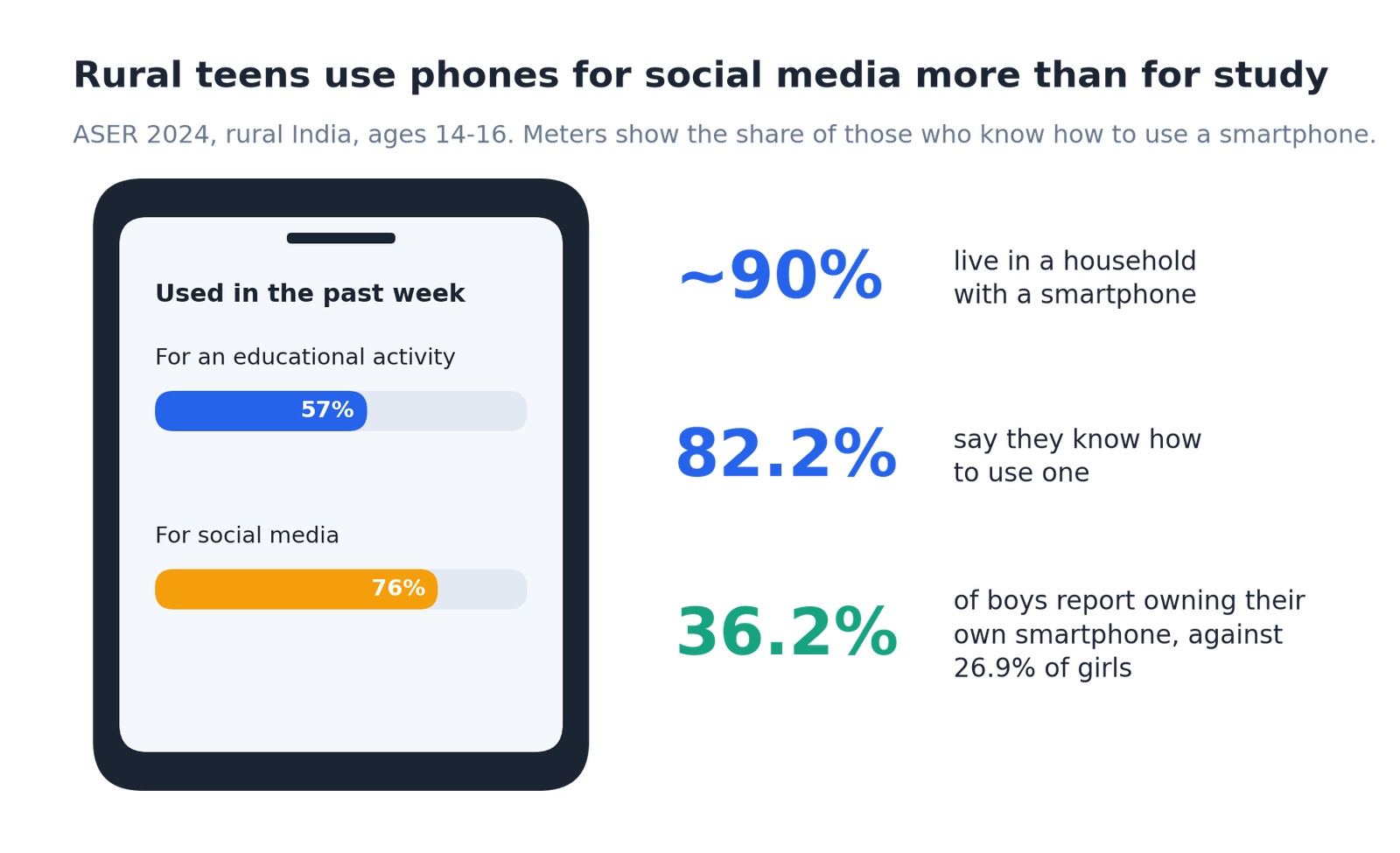
Source: ASER 2024, rural India, children aged 14-16. Figures refer to the 2024 reporting period and are not live data.
Access does not mean ownership or equal opportunity. ASER found that 36.2% of boys reported owning a smartphone, compared with 26.9% of girls. On the survey day, 70.2% of boys and 62.2% of girls could bring a smartphone to perform digital tasks.
More than three-quarters of those who brought a smartphone could perform basic tasks such as setting an alarm, searching for information and finding a YouTube video. These results concern rural India and should not be interpreted as nationwide estimates of online education.
Source: ASER 2024
AI in Education Statistics in India
In October 2025, the Ministry of Education announced that AI and computational thinking would be introduced in schools from Class 3 in the 2026-27 academic year. The curriculum places computational thinking first, covering logical reasoning, pattern recognition, algorithm design and data literacy, before building AI learning on that foundation.
A curriculum for Grades 9 to 12 in AI and allied subjects has also been finalised. The Skill Development Ministry’s Skilling for AI Readiness (SOAR) programme offers three 15-hour AI modules for students in Classes 6 to 12 and a 45-hour module for teachers.
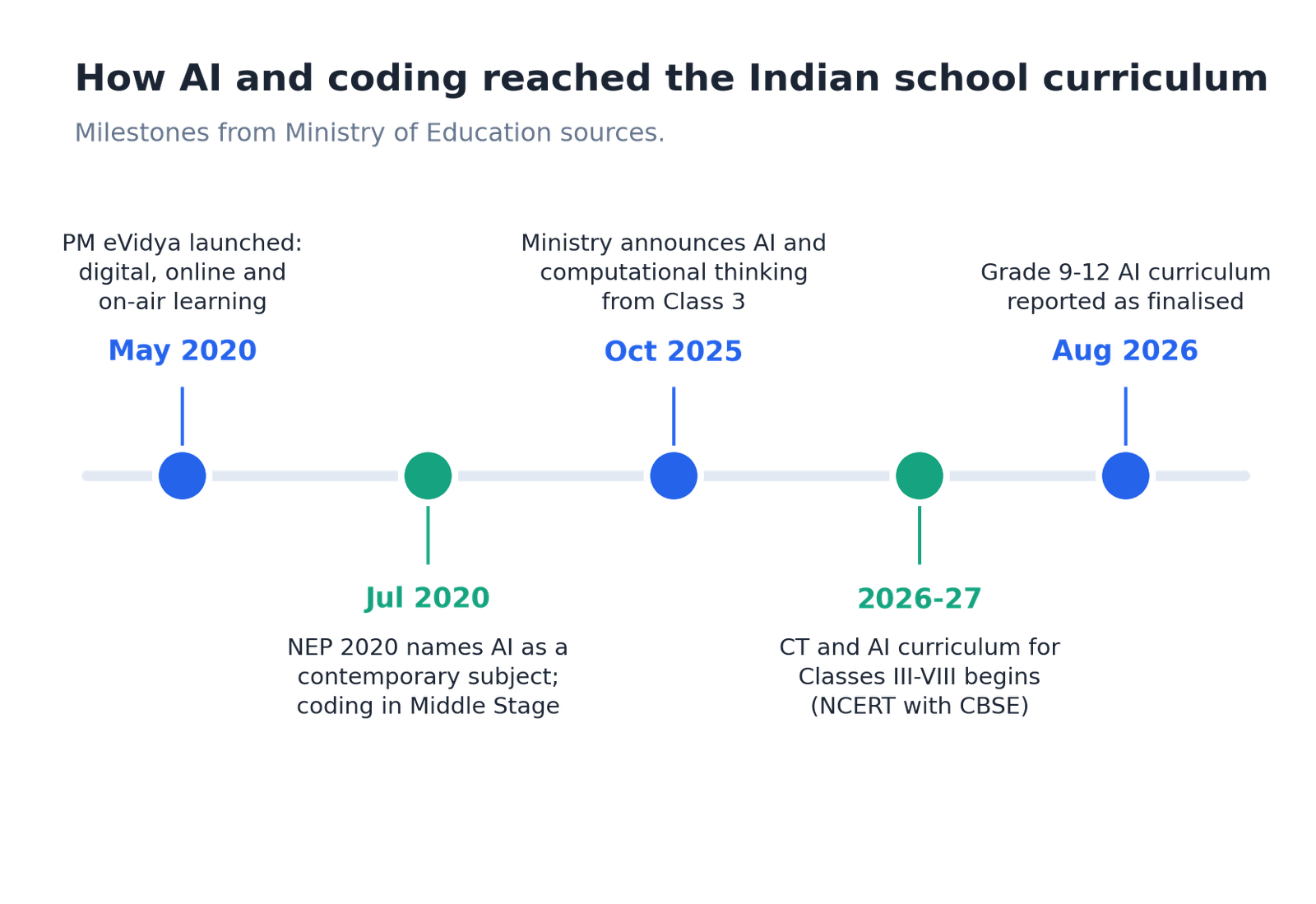
Source: Ministry of Education announcements and parliamentary replies, 2020-2026. These are policy announcements, not live measures of classroom implementation.
Education is a concurrent subject in India, and most schools are under State governments. Responsibility for setting up AI and robotics labs rests with the respective States and Union Territories. CBSE also says its affiliated schools must provide adequate infrastructure for students studying AI.
What children receive in practice can depend on the board, State and individual school. The official datasets covered in this article do not provide a national count of how many Indian students actually use AI tools.
UNESCO’s 2023 survey of more than 450 schools and universities found that fewer than 10% had formal guidance on generative AI: 7% of schools and 13% of universities. This international snapshot highlights why parents should ask whether a school has a clear AI-use policy.
Sources: Ministry of Education | UNESCO GEM Report
Coding for Kids and STEM Education
Coding for kids can range from puzzles and block-based activities to writing simple programs. In Indian schools, the intended progression starts with computational thinking in Class 3, followed by coding activities in the Middle Stage.
School-level data on coding education remains limited. NITI Aayog’s October 2025 roadmap noted that computer science was offered in only some Indian schools, while China and Russia had made it mandatory at primary and secondary levels. The report also described uneven implementation of the CBSE AI curriculum and Atal Tinkering Lab AI modules, alongside a shortage of trained teachers. It predates the new Class 3 to 8 curriculum and describes the starting point rather than its current impact.
Higher education STEM statistics provide another view of the pipeline. STEM enrolment rose from 91.5 lakh in 2014-15 to 1.02 crore in 2023-24. Women’s share of STEM enrolment increased from 38.4% to 44% over the same period.
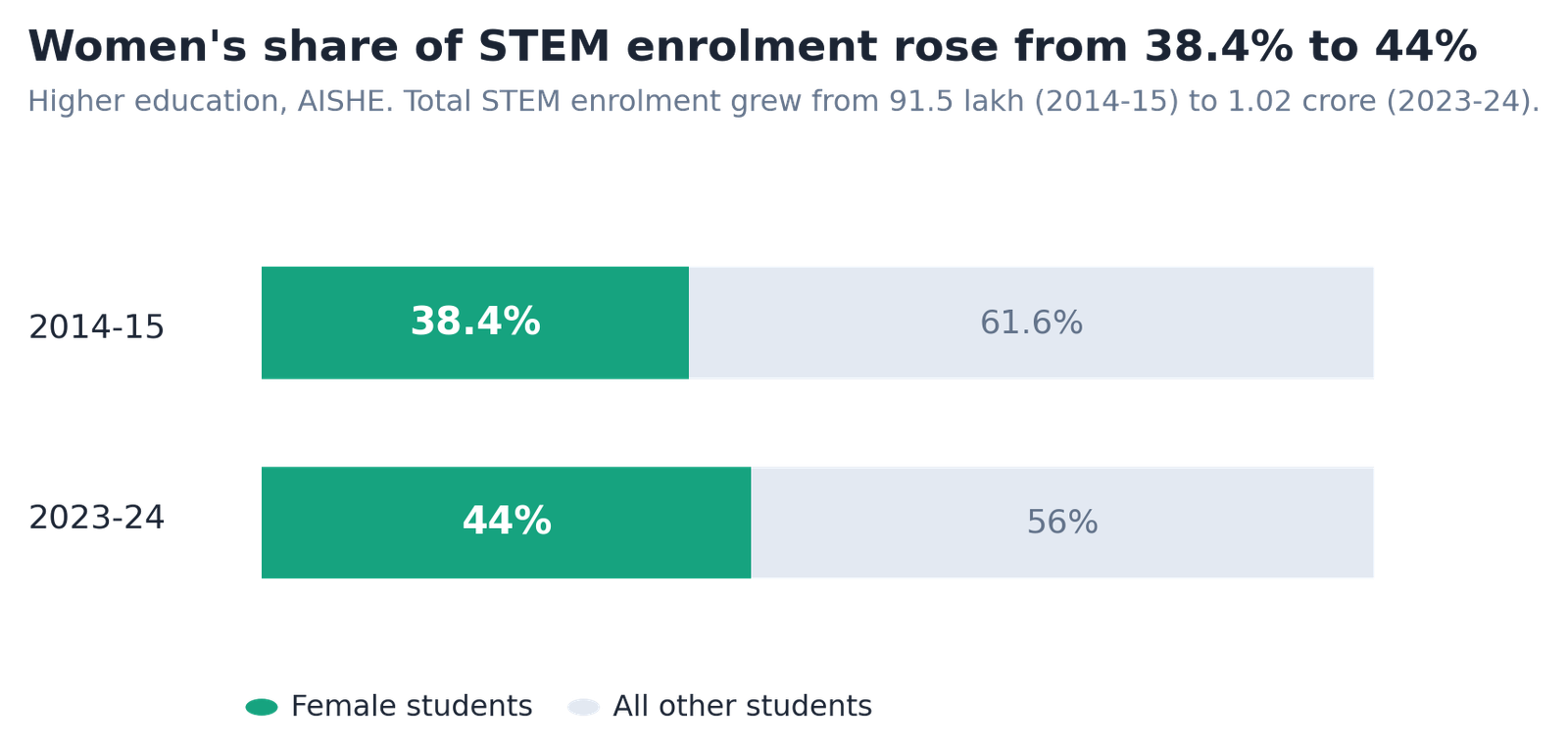
Source: AISHE 2023-24, Ministry of Education. Figures refer to their respective reporting periods and are not live data.
For students interested in engineering, our guide on how to prepare for IIT JEE explains the exam route. Our guide to career options after Class 12 explores paths across science, commerce and arts.
Sources: Ministry of Education | NITI Aayog
Future Skills and 21st-Century Skills
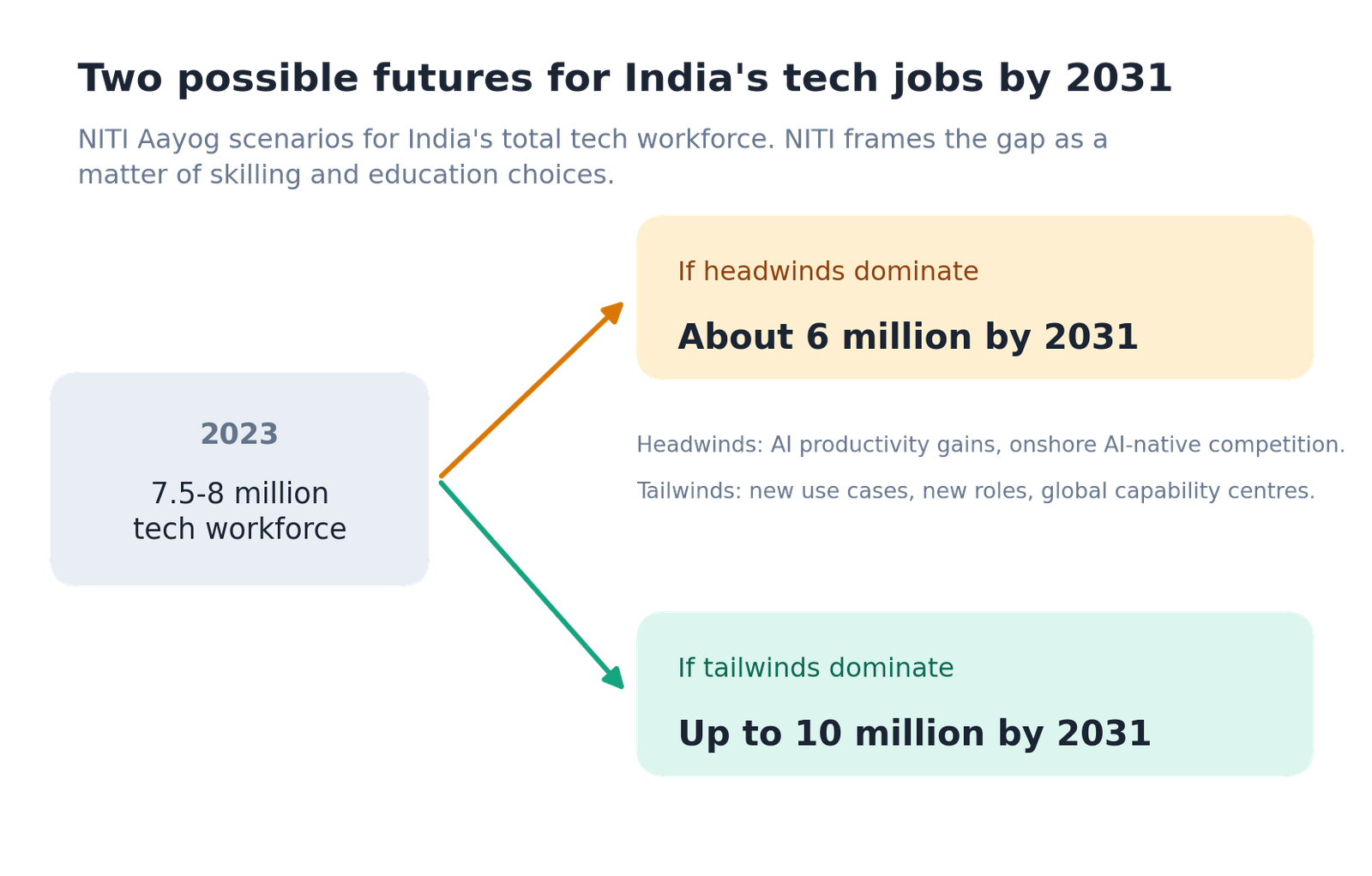
NITI Aayog’s roadmap describes the potential impact of AI on India’s technology workforce. The workforce was estimated at 7.5 to 8 million in 2023. By 2031, it could fall to about 6 million or rise to as many as 10 million, depending on how effectively the country develops skills.
Source: NITI Aayog, Roadmap for Job Creation in the AI Economy, October 2025. These are scenarios, not forecasts or live data.
The report cites a NASSCOM estimate that AI talent supply is about half of current demand. Demand was expected to rise from 8-8.5 lakh to more than 12.5 lakh between 2024 and 2026, at an estimated annual rate of 25%, while the existing talent pool was growing at 15%. These figures concern the technology sector, not school students directly.
Skills that schools can help develop include:
- Digital literacy and responsible technology use.
- Coding, logical reasoning and problem solving.
- Critical thinking and the ability to question AI-generated answers.
- Communication, creativity and collaboration.
- Data literacy and ethical decision-making.
Strong foundations still matter. ASER 2024 found that only 23.4% of rural Class 3 children could read a Class 2 text. Our article on reading comprehension in India explores these learning outcomes. Reading well helps children interpret AI responses, question claims and communicate their own ideas.
Source: NITI Aayog
Technology and Children’s Learning
Evidence about educational technology is more cautious than some marketing claims suggest. UNESCO’s 2023 Global Education Monitoring Report found that impartial evidence about the impact of education technology is limited. EdTech products change every 36 months on average, and some technologies improve some types of learning in specific contexts.
UNESCO’s monitoring also reports that 114 education systems, representing 58% of countries, have a national ban on mobile phones in schools.
The OECD’s January 2026 Digital Education Outlook makes an important distinction: general-purpose generative AI can improve performance on a task without improving learning. Tools used with a clear teaching purpose are more likely to support sustained gains and develop critical thinking, creativity and collaboration. Educational AI can support teachers rather than replace them.
India’s policy framing similarly identifies potential uses such as personalised learning, intelligent assessment and adaptive instruction. However, evidence on student learning outcomes from personalised learning in Indian classrooms is still emerging.
The main lesson is that how technology is used matters more than simply whether it is present. Parents should look beyond smart boards and computer labs to understand how tools are integrated into teaching.
Sources: UNESCO report on technology in education | OECD
Choosing a School for Digital Learning
National statistics provide context, but they cannot tell you how a particular school uses technology. Parents can ask schools the following questions:
- Does the school have working computers and reliable internet?
- Do students use technology in regular lessons, or is it limited to occasional demonstrations?
- Who teaches AI and computational thinking, and what training have they received?
- Does the school have clear rules for AI tools, smartphones and student data?
- Do younger children build reading, writing and maths foundations before relying on digital tools?
Board and State matter because schools may follow different implementation schedules. If you are concerned that your child’s current school is not meeting their needs, read our guide to signs it may be time to change schools.
FAQs: AI, Coding and Digital Learning
What should children learn in the age of AI?
Strong reading and maths foundations remain essential. India’s new curriculum adds computational thinking, including logical reasoning, pattern recognition and problem solving, from Class 3, with AI learning built on that foundation across Classes III to VIII.
How is AI changing education in India?
Policy is an important early driver. AI and computational thinking are planned from Class 3 in 2026-27, an AI curriculum for Grades 9 to 12 has been finalised, and the SOAR programme offers AI modules for students and teachers. The supplied official data does not establish how many students currently use AI tools.
Can AI replace teachers?
The OECD’s 2026 review suggests educational AI can support teaching and tutoring while preserving teachers’ agency. General-purpose AI may improve task performance without producing meaningful learning gains, so teaching guidance remains important.
How can students use AI for learning?
Students can use AI to explore explanations, ask questions and receive feedback rather than simply outsourcing assignments. The value depends on the learning goal and how teachers or parents guide its use.
Should children learn coding and AI?
NEP 2020 and the Ministry of Education support a staged approach: computational thinking from Class 3, coding activities in the Middle Stage and AI learning built on those foundations. Teacher preparation and implementation quality remain important considerations.
What is coding for kids?
Coding for kids teaches children to give precise instructions to a computer, beginning with puzzles and block-based activities and progressing to simple programs. Computational thinking helps develop the reasoning skills needed for coding.
What skills cannot be replaced by AI?
No definitive list can guarantee which skills will remain unaffected. Critical thinking, communication, creativity, collaboration and judgement are valuable capabilities to develop alongside technical knowledge.
How can parents prepare children for future careers?
Build strong reading and maths foundations, encourage responsible use of technology and give children opportunities to practise problem solving and communication. Explore our guide to career options after Class 12 for a wider view of future pathways.
Conclusion
Technology in education in India is expanding through computer facilities, smart classrooms, digital platforms and plans to introduce AI and computational thinking in schools. Yet access to infrastructure does not automatically translate into effective teaching or better learning outcomes.
For parents, the practical question is not simply whether a school uses technology, but how it uses it. Check the availability of devices and internet, teacher preparation, AI policies and the quality of foundational learning. Use official statistics as context, then compare individual schools to make a decision that fits your child’s needs.
Find the Right School for Your Child
Explore CBSE, ICSE & IB schools in Bangalore. Check real-time ratings, dynamic GPS coordinates, and complete fee charts instantly.