NEP 2020: The National Education Policy Explained, With the Data Behind It

NEP 2020, the National Education Policy 2020, is India’s new education policy, replacing the National Policy on Education of 1986. As a new national education policy, it touches nearly every level of schooling and higher education. This guide covers what NEP 2020 actually says, what its core guidelines are, and because good policy explainers shouldn’t stop at intentions, what the latest government and independent data shows about how much of it has actually reached classrooms.
Why India Needed a New Education Policy
The policy it replaced, the National Policy on Education 1986 (last revised in 1992), had governed Indian schooling for close to three and a half decades, a period in which the economy liberalised, the internet arrived, and the workforce India needed to educate for changed almost beyond recognition. A committee led by former ISRO chief Dr. K. Kasturirangan drafted the new framework, submitting its report in 2019 after years of public consultation; the Union Cabinet approved the final policy on 29 July 2020 (Education for All in India, 2025).
The stated ambition was significant: transform India into a “global knowledge superpower” through a holistic, multidisciplinary system built around flexibility, critical thinking, and skills rather than rote content coverage (Education for All in India, 2025). That framing is worth keeping in mind through the rest of this piece, as it is the yardstick the data below is measured against.
About NEP 2020: Meaning, Guidelines, and Where to Read It
The simplest way to answer “what does NEP mean in education” is this: NEP stands for National Education Policy, a national-level framework, not a law, that sets the direction for how India’s schools and colleges should be structured, taught in, and assessed. About NEP 2020, in one line: it is a vision document approved by the Union Cabinet on 29 July 2020, built around five guiding pillars: Access, Equity, Quality, Affordability, and Accountability (Ministry of Education, NEP 2020 policy document).
If you’re looking for NEP 2020 in English, the full policy document, along with translations in 22 scheduled Indian languages, is published on the Ministry of Education’s official site.
Core NEP 2020 Guidelines
- Universal access to education from pre-school to secondary level
- A shift to competency-based learning over rote memorisation
- Multilingual and mother-tongue-based early education, wherever possible
- Multidisciplinary, flexible higher education with multiple entry and exit points
- A target of 6% of GDP in public spending on education
These guidelines are what most “NEP 2020 guidelines” and “NEP guidelines” searches are really asking about, the operating principles behind every specific reform covered below.
NEP 2020 Education System: What 5+3+3+4 Actually Means
The single most-searched structural change under this national education policy is the shift from the old “10+2” school structure to a “5+3+3+4” system. If you’re wondering what NEP 5+3+3+4 means, it breaks down as follows:
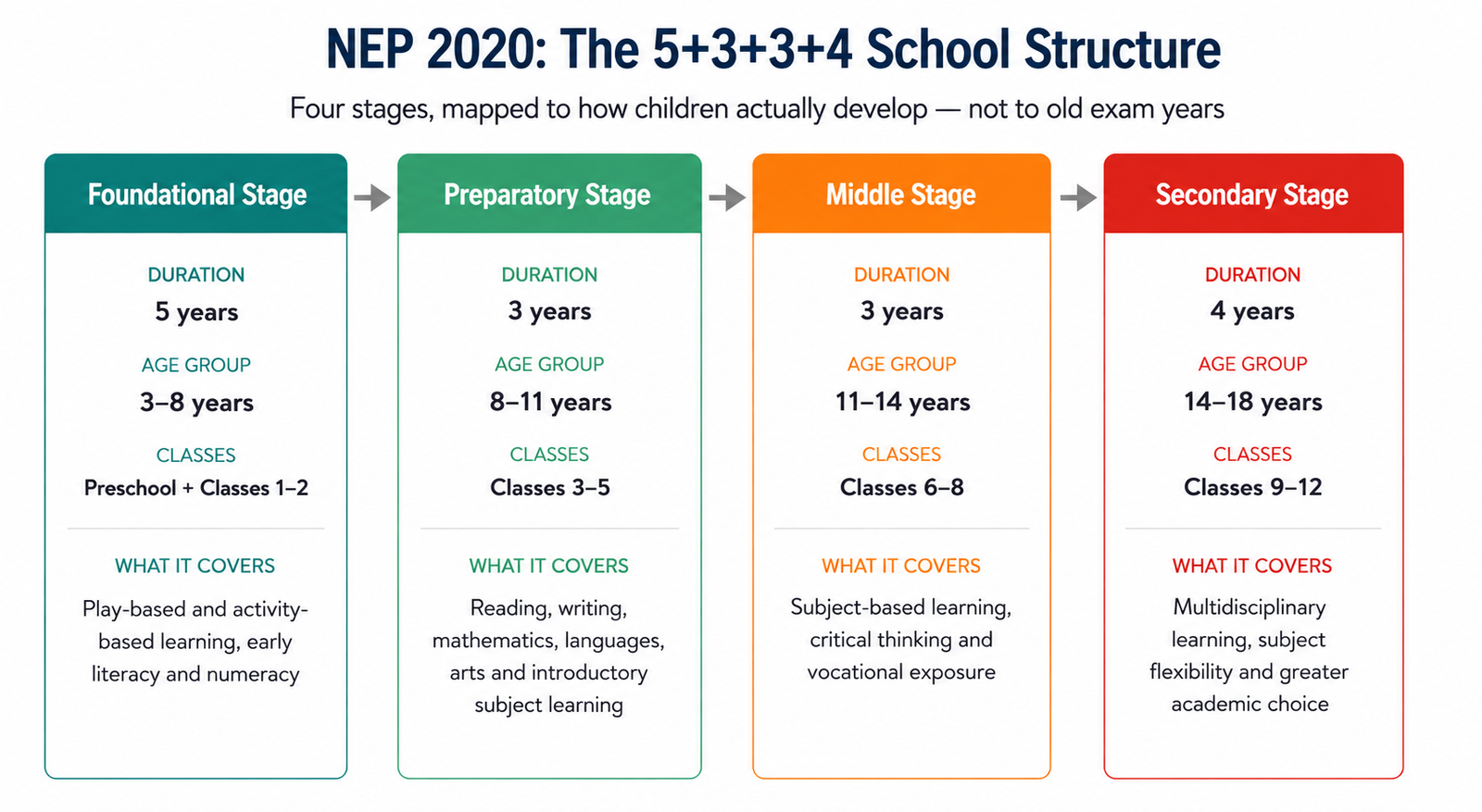
Source: NEP 2020 policy document, Ministry of Education, Government of India.
This new NEP 2020 education system is designed around child development stages rather than exam years. According to UPSC Margin’s 2026 implementation tracker, 32 states and union territories had formally adopted the 5+3+3+4 structure as of mid-2026.
NEP 2020 Rules for Schools and CBSE
One of the more practical NEP 2020 rules parents and students ask about is board exams. Under NEP CBSE guidance, board exams for Class 10 and 12 are meant to move to at least twice a year, with students keeping their best score. CBSE’s official website Karnataka piloted this early; CBSE NEP 2020 implementation formally begins in 2026, with a compulsory sitting in February and an optional improvement attempt in May (Vajiram & Ravi, 2025; Careers360).
A related rule is offering subjects at two difficulty levels, standard and higher. This has so far only been implemented for one subject: CBSE Class 10 mathematics, from 2019-20. NCERT’s official website NCERT’s PARAKH assessment framework, including peer and self-assessment, exists on paper but hasn’t been adopted by most boards yet.
Holistic Education in NEP 2020: What It Means for Students
Holistic education under NEP 2020 is meant to move learning away from a single fixed track and toward flexibility, choice, and continuous assessment. In practice, this shows up through twice-yearly board exams with best-score retention, difficulty-level options in select subjects, and assessment frameworks like PARAKH that emphasise skills over memorisation, even though adoption of some of these pieces is still uneven across states and boards.
Vocational Education and Digital Learning Under NEP 2020
NEP 2020 set one of its most ambitious numeric targets around skills: at least 50% of learners across school and higher education should have exposure to vocational education by 2025, up from a base so low that vocational training was historically treated as a lower-status track (DIKSHA Vocational Education Vertical, Ministry of Education; IMPRI, 2025). The policy explicitly frames this as removing the “harmful hierarchies” between academic and vocational streams, and encourages schools to partner with polytechnics, ITIs, and local industry for hands-on exposure.
Digital learning became a parallel pillar almost by necessity. NEP 2020 was approved just months before COVID-19 shut down classrooms nationwide. Initiatives that grew out of this moment include PM e-Vidya, the DIKSHA platform, and SWAYAM Prabha educational TV channels, all aimed at keeping K-12 learning going when schools couldn’t (IMPRI, 2025). At the higher-education level, adoption has grown substantially: over 90% of higher education institutions now engage with the SWAYAM platform, and online enrolment through it rose from 25,905 students in 2020-21 to more than 100,000 in 2024-25 (Education for All in India, citing Chauhan, 2025).
Newer tools go further than content delivery. The My Career Advisor app, an AI-powered guidance tool, offers personalised career pathway recommendations across roughly 1,500 options for students in Grades 9–12, including ITI students and school dropouts. The TARA App assesses reading fluency for around 700,000 students across 1,200 Kendriya Vidyalayas, and a web-based Local Language Proficiency Test Portal supports testing in 22 languages (Education for All in India, 2025).
The honest caveat: none of the sources reviewed for this piece confirm that the 50%-vocational-exposure target was actually met by 2025. Most describe it as a goal still being built toward, not a milestone reached. And every digital-learning gain comes with the same asterisk noted throughout NEP’s rollout: rural connectivity remains a real constraint, meaning these tools reach some students far more consistently than others (IMPRI, 2025; Education for All in India, 2025).
The Funding Reality Behind This Education Policy 2020
This education policy 2020 recommends public spending on education reach 6% of GDP “at the earliest,” a target first set by the Kothari Commission in 1968 and repeated in every national policy since. It has never been met. Combined Centre-and-state public expenditure on education stood at just 2.7% of GDP in 2021-22, per the Economic Survey of India, and independent tracking by Azim Premji University put it at around 4% as of mid-2026.
The Union government’s own direct budget allocation to education has grown steadily in absolute terms over 2022-23 to 2025-26, even if it hasn’t closed the gap to the 6% target, as shown in Union Budget documents:
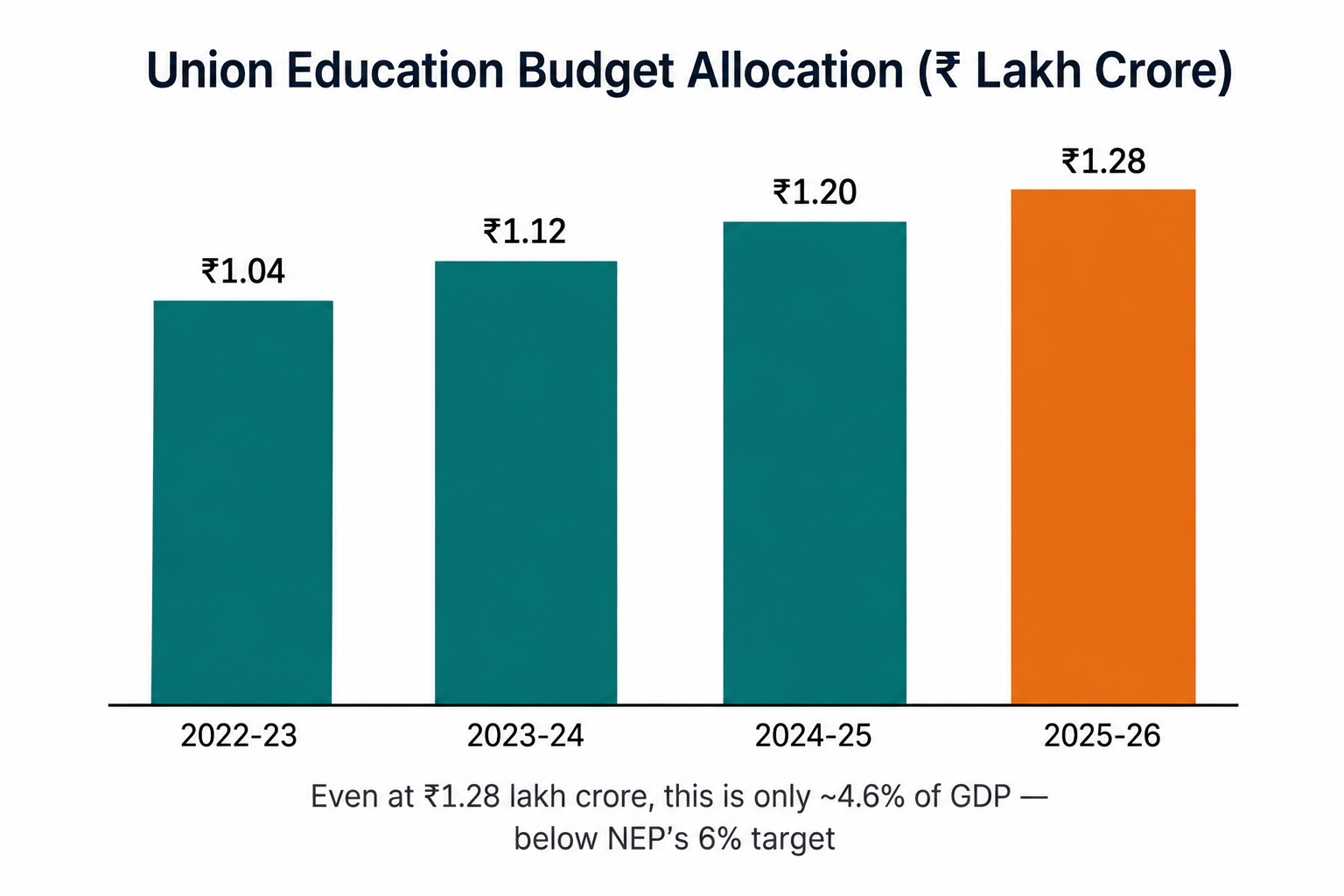
Source: Union Budget documents 2022-23 to 2025-26, Ministry of Finance, Government of India.
The practical effect of this shortfall shows up downstream: NEP’s flagship school-funding scheme, Samagra Shiksha, has actually seen its share of the school-education budget shrink, from 62% in 2019-20 to 51% by 2025-26, even as the number of things it’s meant to fund has grown, according to Azim Premji University’s welfare handbook.
Foundational Learning: A Real Recovery, But Not Yet Back to Where India Started
This is arguably the number that matters most to NEP 2020’s core promise, that every child should be able to read and do basic maths by Class 3. ASER’s household survey shows a genuine post-pandemic recovery, but the starting point matters: reading levels in 2024 are back near where they were a decade earlier, not meaningfully beyond it.
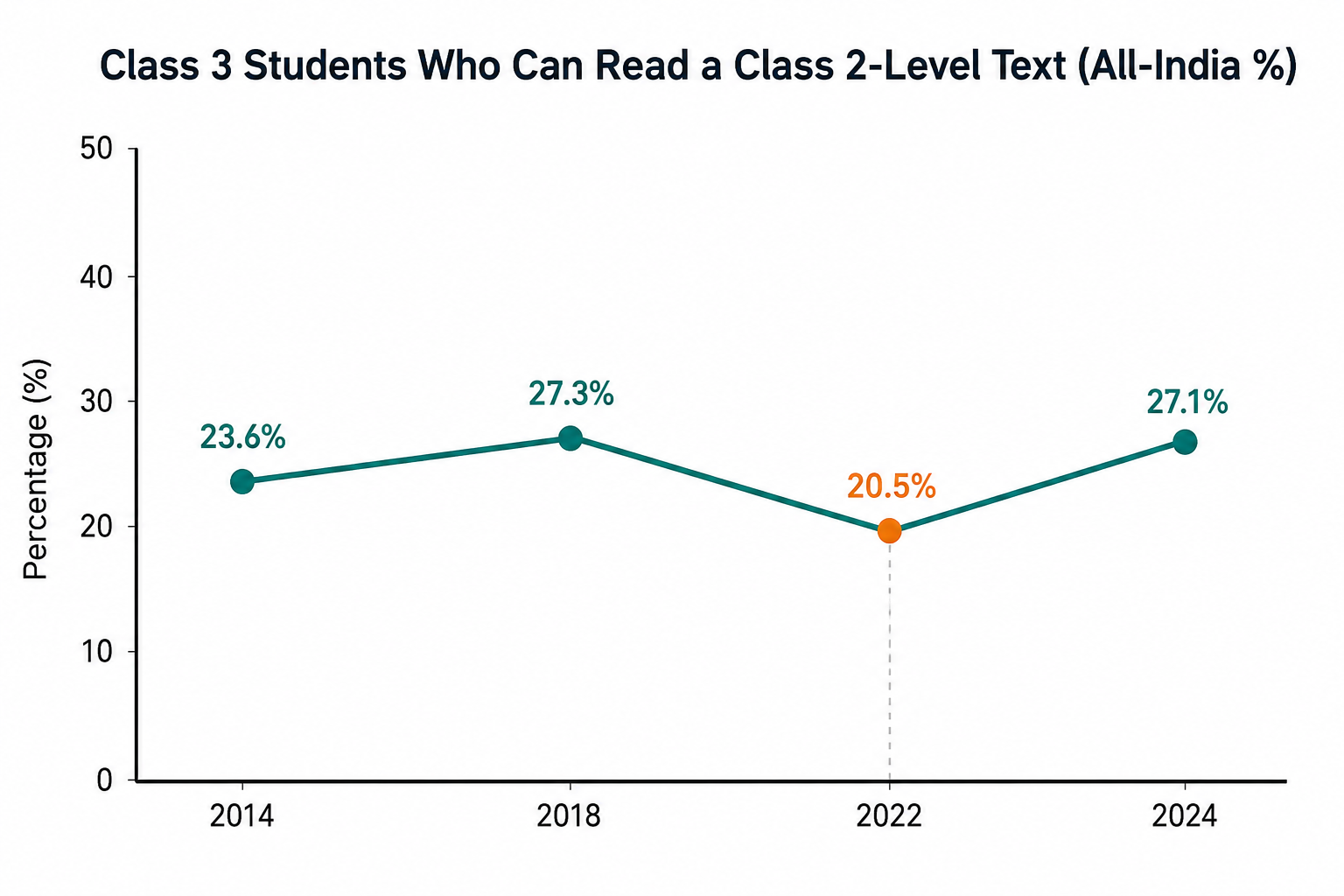
Source: ASER 2024, ASER Centre / Pratham, via analysis by ASER Centre Director Wilima Wadhwa (Ideas for India).
The 2022 dip is the pandemic showing up in the data. Schools were shut for over a year, and reading ability fell sharply. The 2024 recovery was driven disproportionately by government schools, which improved faster than private schools over the same period, according to ASER 2024 coverage in Millennium Post.
Underpinning this is the NIPUN Bharat Mission, NEP’s dedicated foundational-literacy programme, which has trained more than 25 lakh teachers specifically in early-grade reading and numeracy instruction (IMPRI, 2025). That scale of teacher training is exactly why the 2024 recovery is meaningful. It suggests the mission is having a measurable effect, even if it hasn’t yet closed the gap to pre-2018 levels.
NEP 2020 Higher Education: The GER Target Is Still a Long Way Off
On NEP 2020 higher education, the policy set a headline target of raising the Gross Enrolment Ratio (GER) from 26.3% (2018) to 50% by 2035. The most recent official figures put India nowhere close to the pace that target requires.
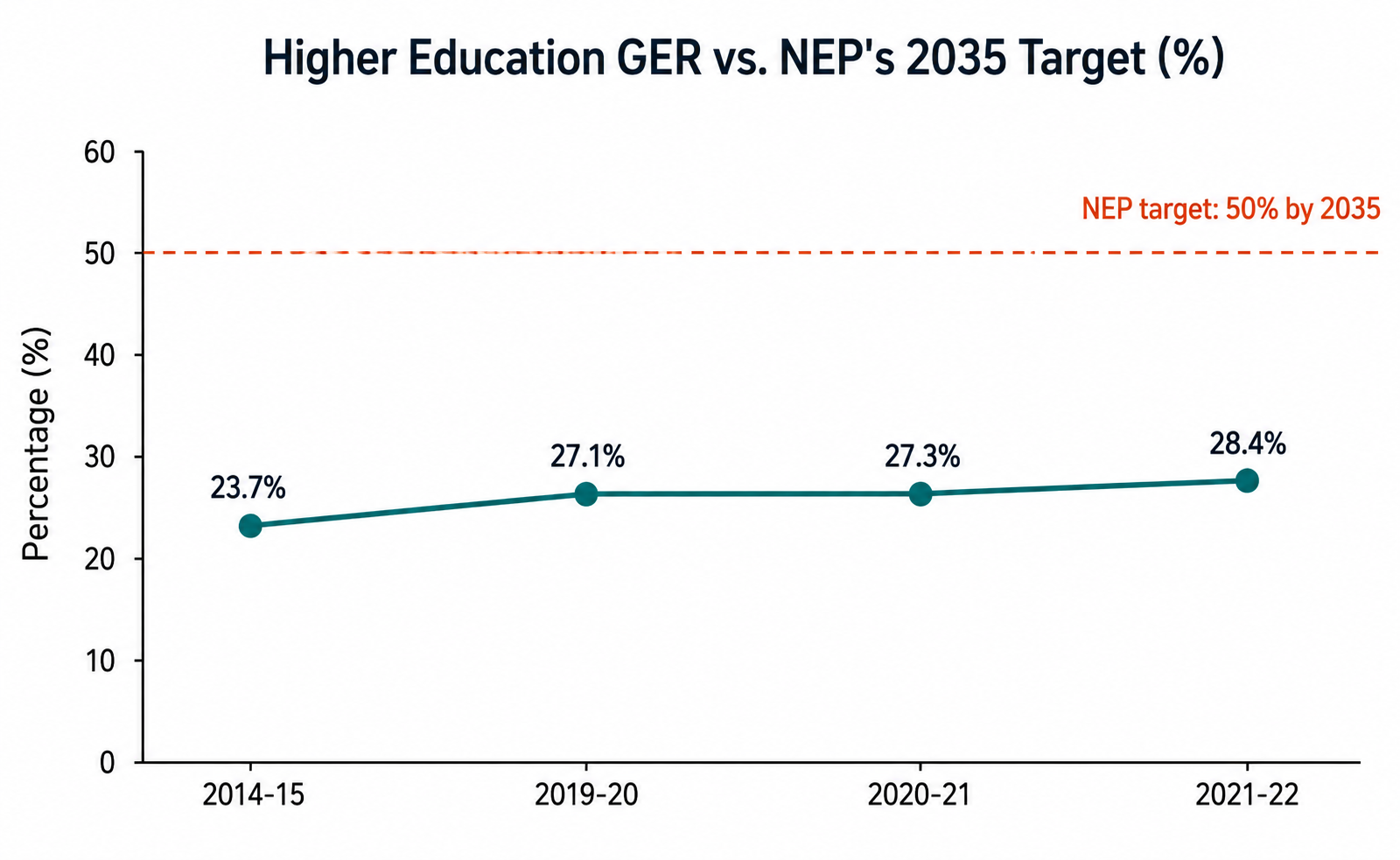
Source: AISHE 2021-22, Ministry of Education / Press Information Bureau.
At 28.4% (2021-22), GER has grown roughly 5 percentage points in seven years, a pace that, unchanged, falls well short of doubling to 50% by 2035. Industry voices flagged exactly this gap at the Education Budget 2026 discussions, reported by Careers360, noting GER remains at 28–30%, far below the target, and pointing out that enrolment growth has outpaced the labs, digital facilities, and skill-based teaching needed to make that growth meaningful. Structurally, the Higher Education Commission of India (HECI), meant to replace the UGC as a unified regulator, remains stalled in legislative process even as other reforms move ahead, according to UPSC Margin’s 2026 tracker.
One genuine bright spot: gender parity. India’s Gender Parity Index in higher education has stayed above 1 for five consecutive years running, meaning women’s GER (28.5%) now slightly exceeds men’s (28.3%), a reversal of a gap that shaped Indian education policy debates for decades (AISHE 2021-22, PIB).
Language Policy: The Recommendation That Became a Flashpoint
NEP 2020’s suggestion that mother-tongue or regional-language instruction should be used “wherever possible” through at least Class 5 was never framed as a mandate. That hasn’t stopped it becoming one of the policy’s most politically contested elements. States including Tamil Nadu and West Bengal have pushed back, framing it as risking indirect Hindi imposition through the accompanying three-language formula, and citing it as a reason for slower, uneven rollout of NEP-linked curriculum in those states, according to reporting by UPSC Margin and Universal Institutions.
Teacher Readiness: The NEP 2020 Policy’s Weakest Link
Every other layer of this NEP 2020 policy, including competency-based textbooks, twice-yearly exams, and multidisciplinary higher education, depends on teachers being trained differently than they were a decade ago. This is where implementation is weakest. The four-year Integrated Teacher Education Programme (ITEP) has launched, but the National Council for Teacher Education (NCTE), the regulator meant to oversee this transition, was reported to be functioning with 54% staff vacancies as of mid-2025, according to Education for All in India’s teacher capacity-building analysis. Continuing professional development requirements exist on paper, with 50 hours per year, but reach depends heavily on state capacity and funding that, as shown above, remains below NEP’s own targets.
Where NEP 2020 Really Stands, Five Years In
Put together, the data tells a consistent story: NEP 2020’s architecture, including new structures, frameworks, missions, and institutions, is largely in place. What’s lagging, almost everywhere the data can measure it, is the resourcing to make that architecture function at the scale of a system this large. The school structure has changed faster than classrooms have. Reading levels have recovered but not surpassed a decade-old baseline. Higher education enrolment is growing, just not fast enough to hit its own target. And the money needed to close these gaps has never reached the level the policy itself recommends.
None of this means NEP 2020 has failed. Structural reform of a system this size was never going to move in a straight line, and several of its numbers, including gender parity, teacher workforce growth, pre-primary enrolment, and SWAYAM adoption, are genuinely strong. But five-plus years in, the honest read of the data is that India has built most of the policy’s blueprint. What it hasn’t yet built, consistently, is the funding and teacher capacity needed to turn that blueprint into what happens in an actual classroom, on an actual Tuesday, for an actual child.
Find the Right School for Your Child
Explore CBSE, ICSE & IB schools in Bangalore. Check real-time ratings, dynamic GPS coordinates, and complete fee charts instantly.