Are Children Learning the Basics? What the Data Says
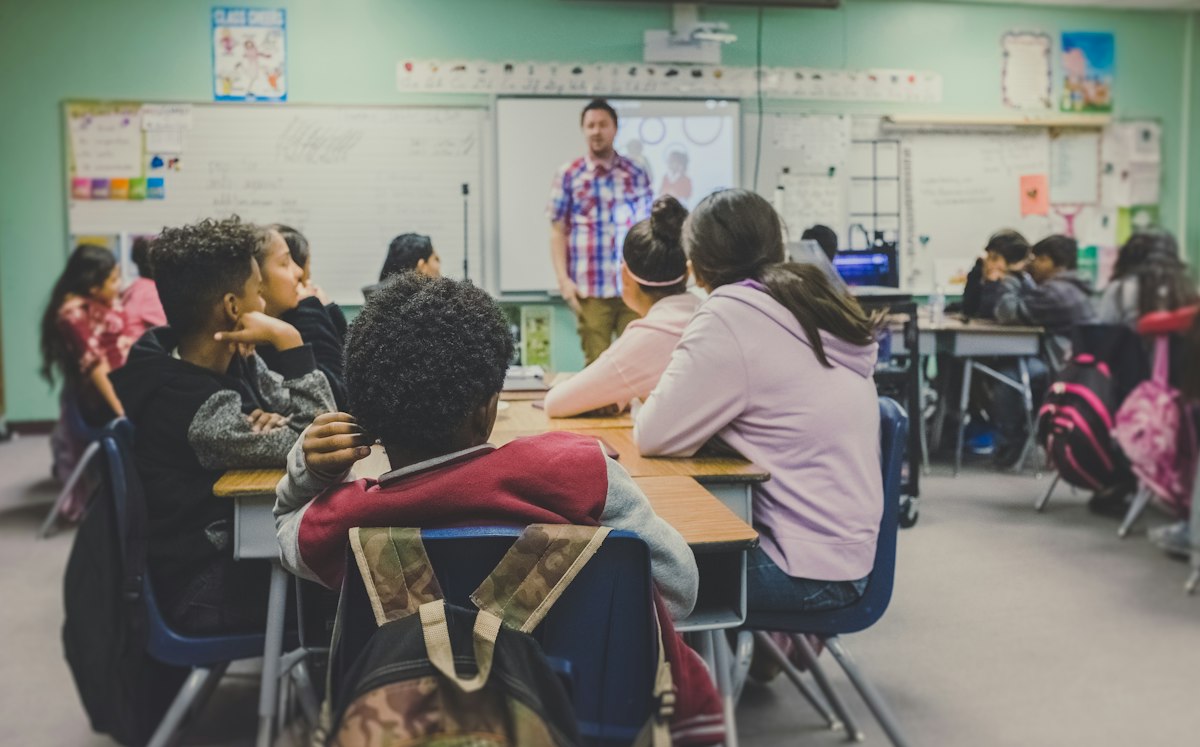
The National Education Policy 2020 made an unusually blunt statement for a government policy document: that the rest of the policy would be “largely irrelevant” for a huge share of India’s students unless they first learned to read, write, and do basic arithmetic. That single line reframed early learning as the foundation everything else in Indian education sits on, not one priority among many, but the one that has to come first. It’s also the reasoning behind NIPUN Bharat, the national mission built specifically to fix it, and it’s why foundational literacy and numeracy has become one of the most closely tracked metrics in Indian education policy over the last five years.
This piece looks at what the data, primarily ASER and PARAKH, actually says about children’s learning in India, specifically whether Indian children are building those basics, and how close the country is to the targets NEP 2020 and NIPUN Bharat Mission set for themselves.
It’s a question that sits at the centre of foundational literacy and numeracy under NEP 2020, and one the latest learning outcomes in India data can now actually answer.
What Is NIPUN Bharat, and Why NEP 2020 Made Foundational Learning the Top Priority
NEP 2020 stated it plainly: foundational literacy and numeracy in primary school must become the highest priority of the education system, with an original target of universal attainment by 2025. That 2025 deadline has now passed. In response, the Ministry of Education launched NIPUN Bharat, the National Initiative for Proficiency in Reading with Understanding and Numeracy, in July 2021, with a revised, more specific target: every child in India attaining foundational literacy and numeracy by the end of Grade 3, by 2026-27, the academic year currently underway.
NEP 2020 identified the scale of the problem driving this urgency: over 5 crore elementary-school children in India lacked basic foundational literacy and numeracy skills at the time the policy was drafted.
NIPUN Bharat Mission responded with a five-tier accountability structure, National, State, District, Block, and School, each with defined responsibilities, and a curriculum framework covering five components of literacy (oral language, decoding, fluency, comprehension, writing) and five of numeracy (pre-number concepts, numbers and operations, shapes, measurement, and data handling).
What Does Foundational Literacy and Numeracy Actually Mean?
Foundational literacy and numeracy, FLN for short, is often used loosely, but NIPUN Bharat defines it fairly precisely: the ability to read with understanding and perform basic numerical operations by the end of Grade 3, treated as the non-negotiable base layer every other subject depends on.
Literacy and numeracy at this stage aren’t graded on complexity, they’re graded on whether a child has the basic mechanics down at all: can they decode words, read a short passage and understand it, write a simple sentence, recognise numbers, and perform basic operations like addition and subtraction.
This is a narrower, more specific bar than “doing well in school” generally. A child can be behind in several subjects and still be fine, foundational literacy and numeracy is different: it’s treated as the prerequisite that determines whether everything built on top of it, from Class 4 onward, has a chance of working.
Are Indian Children Reading at Grade Level? What ASER 2024 Shows
The clearest available measure of grade-level reading comes from ASER, Pratham’s annual rural household survey, which tests whether a child can read text considered appropriate for a level well below their own actual grade.
(Source: ASER 2024. Figures represent the respective reporting periods and are not live data. Historical figures are included where available to show trends over time.)
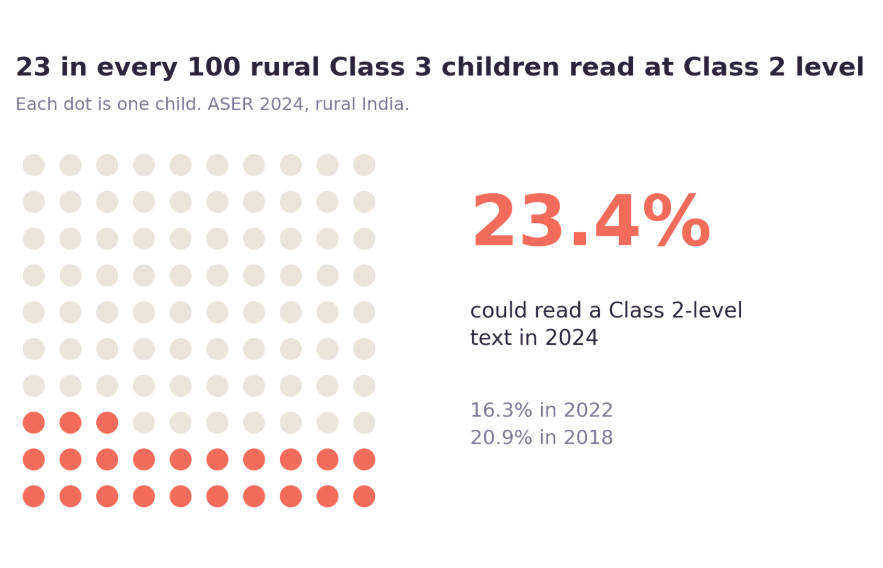
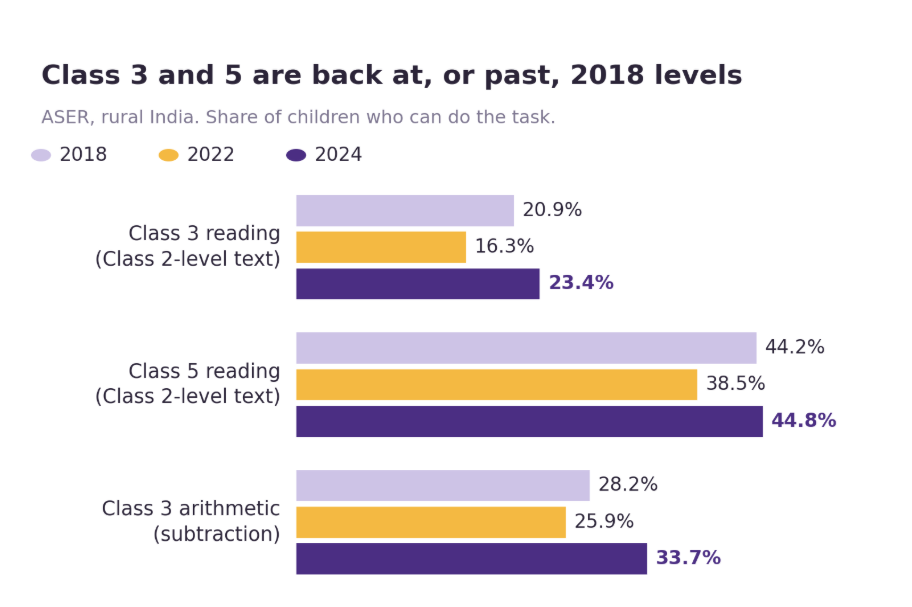
Only 23.4% of Class 3 children could read a Class 2-level text in 2024, up from a pandemic-era low of 16.3% in 2022, and slightly ahead of the 20.9% recorded in 2018. That’s real recovery, but it also means roughly three in four Class 3 children in rural India still fall short of NIPUN Bharat’s core benchmark, with the mission’s 2026-27 deadline now just months away. These ASER reading levels at Class 5 and Class 8 show the same dip-and-recover pattern, though the gap narrows only slightly as children move up through school, which is consistent with the idea that a foundational gap left unaddressed in the early grades tends to persist rather than resolve itself.
Foundational Numeracy: Are Children Building Strong Math Basics?
Numeracy follows a similar arc, and shows a sharper post-pandemic rebound than reading did. ASER numeracy data is the clearest available window into this specific skill nationally.
(Source: ASER 2024. Figures represent the respective reporting periods and are not live data. Historical figures are included where available to show trends over time.)
The share of Class 3 children who could solve a basic subtraction problem rose to 33.7% in 2024, up from 25.9% in 2022 and above the 28.2% recorded in 2018, per ASER 2024. NCERT’s newer PARAKH assessment shows an even sharper recovery on the same metric.
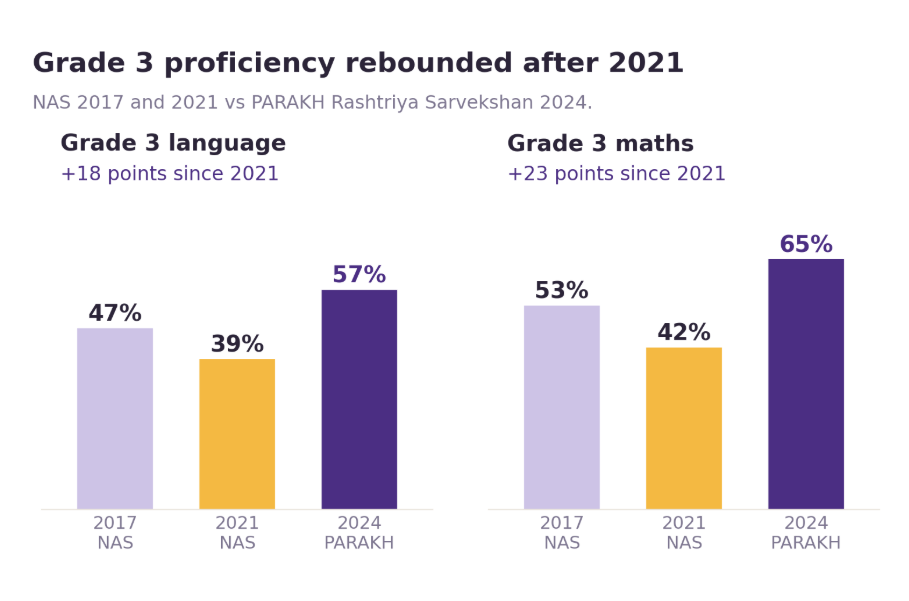
PARAKH found 65% of Grade 3 students proficient in mathematics in 2024, up sharply from 42% in 2021 and 53% in 2017, a full recovery from pandemic-era learning loss on this specific measure, and the strongest improvement of any foundational metric covered here. Two independently run surveys, one rural household-based, one national and school-based, pointing the same direction is a meaningfully stronger signal than either alone.
What a National Assessment Adds: PARAKH Rashtriya Sarvekshan 2024
(Source: PARAKH Rashtriya Sarvekshan 2024, NCERT. Figures represent the respective assessment cycles and are not live data.)
On language specifically, PARAKH recorded 57% of Grade 3 students proficient in 2024, up from 39% in 2021 and 47% in 2017. But within that Language score, reading comprehension was the single weakest sub-skill nationally, at 60%, well behind the 67% recorded for using language in everyday interactions.
That gap matters: a child can recognise words and follow spoken instructions reasonably well while still struggling specifically to comprehend what they read, which is precisely the skill foundational literacy is meant to secure before a child moves past Grade 3.
Rural vs Urban Education: How Big Is the Gap in Foundational Learning?
This is where PARAKH’s national, school-based design adds something ASER’s rural-only survey can’t: a direct rural-urban comparison. And the result runs against the common assumption. At Grade 3, PARAKH found rural students performed slightly better than their urban counterparts in both language and mathematics, with state government schools topping the Grade 3 results overall, an early positive signal for NIPUN Bharat, which has focused its implementation effort heavily on government schools in exactly this age group.
The type of school can also influence how parents interpret these learning outcomes. If you are comparing government and private schools for your child, it is useful to look beyond general perceptions and understand differences in fees, infrastructure, teaching, learning outcomes and other factors. Read our guide to government vs private schools in India.
That pattern doesn’t hold as children move up. By Grade 6, the gap reverses: urban students pulled ahead of rural students by roughly 4 percentage points in language, and PARAKH’s report notes urban-rural and gender-based gaps became more pronounced at the preparatory and middle stages generally.
Reading together, this suggests NIPUN Bharat’s early-grade, foundational-stage focus may be having a genuine, measurable effect in rural India specifically, while the harder unresolved problem is what happens after Grade 3, when that early rural advantage doesn’t carry forward.
Is NIPUN Bharat’s 2026-27 Target Within Reach?
The honest answer is: not by the letter of the original goal, but the direction is genuinely better than it looked two years ago. NIPUN Bharat’s 2026-27 deadline is the current academic year, and ASER 2024 and PARAKH 2024 were both the most recent full assessments available heading into it. Neither shows universal foundational literacy and numeracy achieved, roughly three in four Class 3 children in ASER’s rural sample still can’t read a Class 2-level text, and PARAKH’s own Grade 3 language proficiency, while recovered past 2017 levels, still sits at 57%, not the 100% the mission’s name implies.
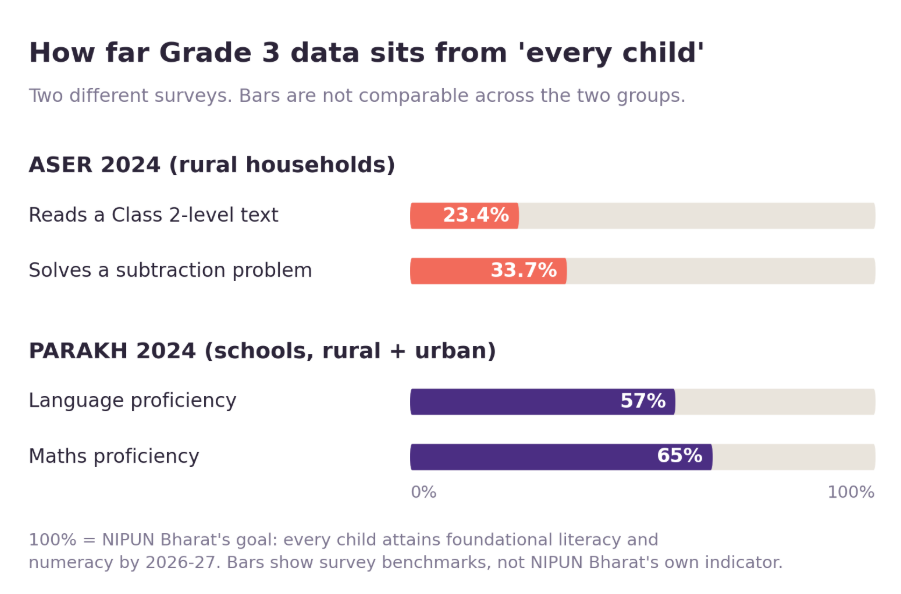
(Source: ASER 2024; PARAKH Rashtriya Sarvekshan 2024, NCERT. Different surveys and benchmarks, not directly comparable. Figures are not live data.)
What the data does show is a recovery that’s outpacing the pre-pandemic trajectory on several measures, particularly numeracy, and early evidence that the mission’s rural, government-school-focused early intervention is showing up in the Grade 3 numbers specifically. Whether that translates into the preparatory and middle grades, where PARAKH shows the gaps reopening, is the unresolved part of the story, and likely the more important one for whether NIPUN Bharat’s broader goals are met, not just its Grade 3 checkpoint.
What This Means for Parents
National FLN data explains the system-level picture, but it can’t tell you whether a specific pre-primary or primary school is actually building these basics in your child. This is worth asking about directly and concretely: how the school teaches early reading and number sense, not just what it claims to cover; whether it tracks individual foundational skills, decoding, comprehension, basic operations, rather than only end-of-year exam scores; and how much weight it places on the early grades generally, since a school’s foundational-stage approach in Nursery through Class 2 shapes everything that follows far more than its Class 10 board results suggest.
This is exactly the kind of school-level detail that’s easy to overlook when comparing schools on brand, fees, or board alone. Search and compare schools on BodhaNow to see how individual schools actually approach the early years, not just their overall reputation.
Find the Right School for Your Child
Explore CBSE, ICSE & IB schools in Bangalore. Check real-time ratings, dynamic GPS coordinates, and complete fee charts instantly.