How Learning Is Changing in the Digital Age
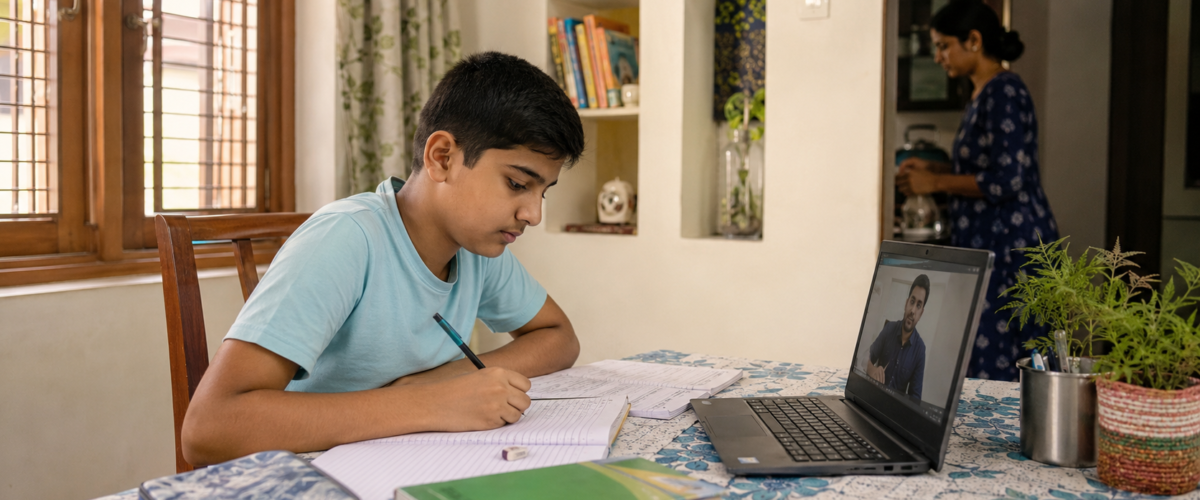
Digital technology is changing where children learn, how quickly they receive feedback, and how easily lessons can adapt to individual needs. Learning is no longer restricted to one classroom, one explanation, or one fixed pace.
Digital Learning at a Glance
| What is changing? | Traditional approach | Digital-age approach |
|---|---|---|
| Where learning happens | Mainly in a classroom or tuition centre | At school, at home, or from any connected location |
| How lessons are delivered | One explanation for the whole class | Live explanations, videos, simulations, shared screens, and interactive exercises |
| Learning pace | Usually decided by the class timetable | Can be adjusted according to the student |
| Feedback | Often received after homework or tests are graded | Can be immediate or provided during the lesson |
| Access to teachers | Usually limited by location | Students can connect with tutors from other cities and regions |
| Parent involvement | Mostly report cards and parent-teacher meetings | Lesson summaries, attendance records, assessments, and progress reports |
| Revising a lesson | Depends on notes, textbooks, or teacher availability | Lessons and resources can often be revisited |
Three Numbers That Explain the Shift
Digital access has expanded rapidly, particularly among older school students in India. However, the way children use that access tells a more complicated story.
Almost 90% of rural Indian children aged 14–16 reported having a smartphone at home in the ASER 2024 survey.
More than eight in ten children in this age group said they knew how to use a smartphone.
Among children who could use a smartphone, only 57% reported using it for an educational activity during the reference week.
These numbers reveal something important. Access to technology is expanding quickly, but access alone does not create meaningful learning.
A smartphone can be used to watch a concept explanation, attend online tuition, practise a language, or solve a quiz. It can just as easily become another source of distraction. What matters is whether the technology is being used with structure, purpose, and appropriate guidance.
The Classroom Is No Longer the Only Place Where Learning Happens
For generations, education followed a predictable structure. A teacher explained a concept to the entire class, students completed the same exercise, and the lesson moved forward according to the timetable.
That structure still has value. Schools give children routine, friendships, collaboration, and exposure to different subjects. However, a classroom also has an unavoidable limitation: one teacher must teach many students at the same time.
Imagine a class learning fractions. One student understands the concept immediately. Another needs to see it drawn. A third understands only when fractions are connected to pizza slices, money, or cricket scores.
The teacher may explain the lesson well, but there is rarely enough time to teach every concept in three or four different ways.
Digital learning creates space for those differences. A student can pause an explanation, attempt another example, return to an earlier topic, or ask a tutor to slow down. Learning no longer has to stop when the school bell rings, and every child does not have to reach understanding through the same route.
Online Tuition Is Becoming More Personal, Not Less
There is a common assumption that learning through a screen must feel distant or impersonal. That may be true of a crowded webinar or a collection of prerecorded videos. It does not have to be true of live online tuition.
A good online class is still built around a relationship between a student and a teacher. Technology simply gives the teacher more ways to observe, explain, and respond.
Consider two students who both score 6 out of 10 on a science assessment. Their marks look identical, but the reasons may be completely different.
The first student understands the science but misreads longer questions. The second remembers the definitions but struggles to apply them. Giving both children the same worksheet will not address the real problem.
During a live one-to-one class, a tutor can watch how each student approaches a question. Does the child rush through the instructions? Do they hesitate at a particular step? Can they explain why they selected an answer?
That information helps the tutor decide what the child needs next.
This is where online tution becomes more than additional class time. It becomes targeted academic support built around the learner rather than the lesson plan alone.
Students Are Moving From Receiving Information to Using It
Traditional lessons can sometimes place students in the role of listeners. Digital learning can make them active participants.
Instead of only reading about the solar system, a child can explore an interactive model. Instead of memorising the parts of a sentence, they can rearrange words and immediately see how the meaning changes. Instead of watching a teacher solve an equation, they can write their own steps on a shared whiteboard.
A tutor can then ask, “Why did you choose that method?”
A correct answer shows that the child reached the destination. Explaining the method shows whether they understood the journey.
Interactive learning works best when students have to think, test, discuss, and correct themselves. The screen should not do the thinking for the child. It should give the child more opportunities to think.
Feedback Is Becoming Faster and More Useful
In a conventional setting, a student might submit homework on Monday and receive it back several days later. By then, the class may have moved to another topic, and the student may barely remember why they chose a particular answer.
Digital learning can shorten that gap.
A quiz can reveal which questions caused difficulty. A tutor can review a solution during the same session. Parents can receive lesson summaries or periodic progress reports instead of waiting for an examination to discover that their child has been struggling for months.
However, useful feedback is not simply “correct” or “incorrect.”
Imagine a child enters the wrong answer to a division problem. An automated tool can flag the mistake immediately. A skilled tutor can go further and identify that the child does not fully understand place value.
One corrects the answer. The other addresses the cause.
Parents Can See More Than Marks
Parents usually see the outcome of learning: test scores, completed homework, report cards, or a child saying school was “fine.”
Digital learning can make the process more visible.
Attendance records show whether classes are consistent. Assessment results reveal recurring gaps. Lesson summaries tell parents what was covered. Progress reports can show whether a child is improving in accuracy, confidence, speed, or independent problem-solving.
This does not mean parents need to monitor every lesson. Children still need room to make mistakes without feeling watched.
Instead of asking, “Why are your math marks low?”, a parent can ask, “I noticed word problems are still difficult. Which part feels confusing?”
The second question gives the child something specific and safe to respond to.
Access to the Right Tutor Is Expanding
Earlier, tutoring options were usually determined by geography. Families chose from the teachers available nearby, even when the tutor taught a large batch or did not suit the child’s learning style.
Online tuition removes much of that geographical restriction. A student can find a subject specialist, learn from a tutor familiar with their school board, or choose someone who can explain a concept in the language the child understands best.
The right tutor is not necessarily the person with the longest list of qualifications. It is the person who notices when a child is confused, changes the explanation, and creates enough trust for the child to say, “I still don’t understand.”
Technology makes that match easier to find. Proper tutor verification makes it safer and more dependable.
Does More Technology Automatically Mean Better Learning?
No. More technology does not automatically produce better learning.
A child can spend two hours moving between educational videos and retain very little. Another can spend 30 focused minutes solving problems with a tutor and leave with a much clearer understanding.
The difference is not only screen time. It is what the child is doing during that time.
Myth: An “AI-powered” platform automatically provides personalized learning
Reality: A platform may recommend content based on test answers, but genuine personalization also requires an understanding of why the child is struggling, how they respond to different explanations, and what motivates them to participate.
Myth: More screen time means more digital learning
Reality: Screen time can be passive or active. Watching several videos without reflection is very different from solving a problem, discussing a concept, receiving feedback, and trying again.
- Are the classes live, recorded, or a combination of both?
- Can the tutor change the lesson when the student struggles?
- Are tutors verified before they begin teaching?
- Is the student actively solving, discussing, and asking questions?
- Is progress assessed regularly?
- Will parents receive meaningful feedback?
- Does the teaching match the child’s grade, board, and learning goals?
The platform matters, but the quality of teaching matters more.
What Will the Future of Learning Look Like?
The future of education is unlikely to be entirely online or entirely classroom-based. It will combine the strengths of both.
Schools will continue to give children structure, community, teamwork, and broad academic experiences. Digital tools will provide flexible access, additional practice, faster feedback, and targeted support. Live tutors will help students work through learning gaps that can be difficult to address in a large classroom.
For parents, the question is no longer, “Is online learning better than classroom learning?”
A better question is: “What combination of support will help my child learn well?”
For one child, that might mean weekly mathematics tuition. Another may need a short concept-reinforcement programme before an examination. A third may need a patient tutor who can rebuild their confidence after months of feeling left behind.
Learning in the digital age is changing because education can now respond more closely to those differences. Technology is an important part of the change, but it is not the heart of it.
The real change is simpler: education is beginning to fit the learner instead of always expecting the learner to fit the system.
Frequently Asked Questions
What is learning in the digital age?
Learning in the digital age uses technology to support teaching, practice, communication, assessment, and feedback. It may include live online classes, digital whiteboards, educational videos, interactive exercises, learning platforms, and AI-supported tools.
How has technology changed the way students learn?
Technology allows students to access lessons from different locations, revisit difficult topics, receive faster feedback, use interactive resources, and learn at a more flexible pace.
Is online tuition effective for school students?
Online tuition can be effective when classes are live and interactive, tutors are qualified and verified, lessons match the student’s needs, and progress is assessed regularly. Simply placing a student in front of a screen does not guarantee learning.
Can online tuition replace school?
Online tuition is generally most useful as a complement to school rather than a complete replacement. It can provide individual attention, targeted concept support, homework assistance, exam preparation, and additional practice.
What should parents look for in an online tutor?
Parents should consider the tutor’s subject knowledge, verification, experience with the relevant grade and curriculum, communication style, ability to adapt explanations, and approach to feedback and progress tracking.
Find the Right School for Your Child
Explore CBSE, ICSE & IB schools in Bangalore. Check real-time ratings, dynamic GPS coordinates, and complete fee charts instantly.