Government School vs Private School in India: What Do the Numbers Really Say?

India has close to 25 crore children in school, split across government and private classrooms in almost every town and city in the country. For most parents, the choice between the two isn’t really a choice between two abstract categories, it’s a decision made under pressure, on assumptions passed down from other parents, from advertising, from what “everyone knows” about private schools being better. Is a private school actually better than a government school? The honest answer depends on more than which category a school falls into.
This piece compares government and private schools in India using actual education India statistics, fees, facilities, teachers, enrollment, and learning outcomes, drawn primarily from UDISE+, the Ministry of Education’s national school database, alongside ASER and PARAKH for learning outcomes. The goal isn’t to declare a winner between private school vs government school. It’s to show what the data actually says, so the government-vs-private question can turn into a more useful one: which specific school is right for your child.
Two Types of Schools: How Do They Actually Differ?
The core difference is who runs the school and who pays for it. Government schools are run and funded by state or central government departments, this includes State Government schools, Kendriya Vidyalayas, Navodaya Vidyalayas, and other central government schools. Government-aided schools are privately managed but receive government funding, which typically keeps their fees low despite being run by a private trust or society. Private unaided schools receive no government funding, they’re run entirely on fees, donations, and private management, which is why their costs and admission processes vary so widely from one school to the next.
This distinction matters more than the general “government vs private” framing suggests, and it’s the starting point for understanding the difference between government and private schools. A government-aided school often looks, fee-wise, closer to a government school than a private one, even though it’s privately managed. Admission structures follow the same split: government schools generally admit based on neighbourhood catchment and Right to Education Act provisions, while private unaided schools set their own admission criteria, interviews, entrance tests, sibling priority, that vary school to school and city to city.
India’s School Landscape: Who Runs the Most Schools?
Understanding how many government schools in India exist, relative to private ones, is the natural starting point. According to the UDISE+ 2025-26 Booklet, Table 1, India had 14,66,682 schools in the 2025-26 academic year, broken down as follows.
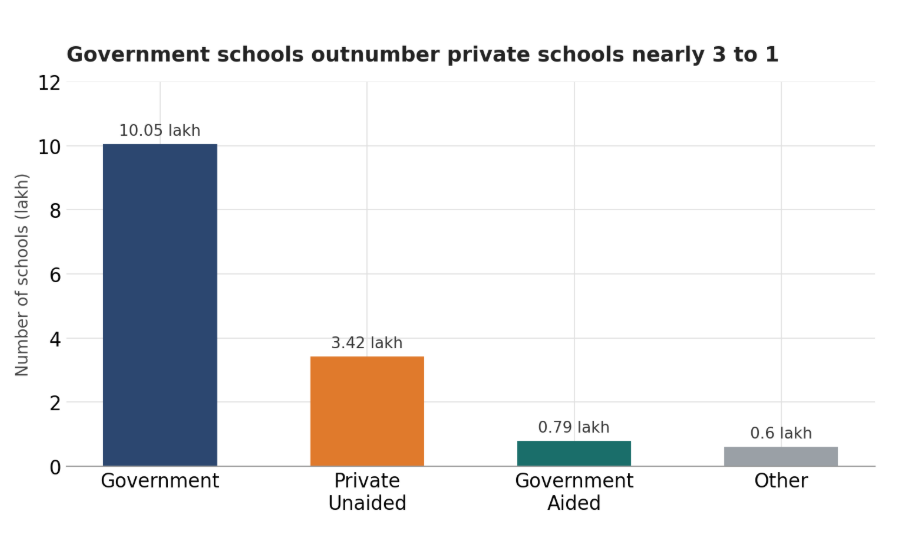
(Source: UDISE+ 2025-26, Table 1. Figures represent the 2025-26 reporting period and are not live data.)
Government schools, 10,05,245 in total, make up 68.5% of all schools in India. Private unaided schools account for 3,41,689, or 23.3%, government-aided schools for 79,261 (5.4%), and the remainder are recognised madrasas and other school types. In sheer numbers, government schools dominate the landscape, they exist in far more villages, blocks, and neighbourhoods than private schools do, which is part of why government schooling remains the only realistic option in a large share of rural India.
Where Are India’s Students Actually Studying?
School count is only half the picture. Enrolment tells a different story.
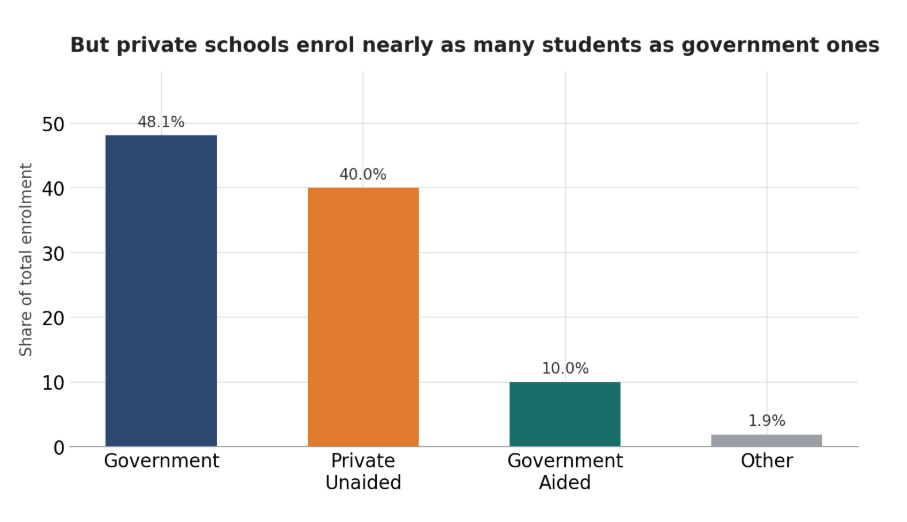
(Source: UDISE+ 2025-26, Table 1. Figures represent the 2025-26 reporting period and are not live data.)
Of the 24,72,19,766 students enrolled in 2025-26, government schools account for 11,89,03,585 students (48.1%), private unaided schools for 9,88,63,908 (40.0%), government-aided schools for 2,46,19,692 (10.0%), and other schools for the remainder, per the same UDISE+ 2025-26 Booklet..
The gap between school share and enrollment share is the real story here: government schools are 68.5% of all schools but only 48.1% of enrollment, while private unaided schools are 23.3% of schools but 40.0% of enrollment. That means the average private school in India serves considerably more students per campus than the average government school. This doesn’t say anything about quality, larger enrolment can reflect demand, but it can just as easily reflect urban concentration, since private schools cluster more heavily in cities and towns while government schools are spread thinner across rural India to ensure geographic access.
What Does Schooling Really Cost Parents?
This is where a lot of comparisons go wrong, so it’s worth being precise. There is no reliable, nationally comparable figure for “average private school fees in India.” Fees vary dramatically by state, city, board, grade, and individual school, a private school in a Tier-1 city charging a CBSE curriculum with air-conditioned classrooms and a private school in a small town offering a state-board curriculum are not comparable line items, and no credible national dataset averages them into one meaningful number. Anyone quoting a single “average private school fee” for India is either working off a very limited sample or an estimate not grounded in comprehensive data.
What can be said with more confidence is the structure of costs. Private unaided schools typically charge tuition fees directly, since they receive no government funding, and parents may also encounter admission-related charges, transport fees, uniforms, books, and activity or facility fees on top of tuition. Government schools, by contrast, do not run on a comparable tuition-fee model, they’re funded through state and central government budgets, and schemes like Samagra Shiksha and PM POSHAN (the mid-day meal programme) cover meals and, in many states, textbooks and uniforms as well. That doesn’t mean government schooling is entirely cost-free for every family in every state, there can still be incidental costs, but the fee structure is fundamentally different from a private school’s, where tuition is the primary and largest line item.
Government-aided schools sit in between: privately managed, but with government funding that generally keeps fees far lower than a comparable unaided private school.
School Facilities: Who Has the Better Infrastructure?
Nationally, UDISE+ 2025-26 reports that 95.0% of Indian schools have electricity, 99.5% have drinking water, 99.1% have toilet facilities, 90.5% have a library or reading corner, 81.9% have a playground, 69.9% have computer facilities, and 67.4% have internet access..
These are national aggregates across all school types combined, and UDISE+ does track several of these indicators by management category specifically. What’s clear from the aggregate picture is that basic infrastructure, electricity, water, toilets, has become close to universal across Indian schools regardless of management type, while more advanced infrastructure, computers, internet, functional digital labs, still varies considerably and tends to concentrate more heavily in urban and better-resourced schools of any category, government or private. The presence of a facility is also not the same as it being well-used: a computer lab that exists on paper isn’t automatically a computer lab used for regular instruction.
Teachers and Student-Teacher Ratios: What Does the Data Show?
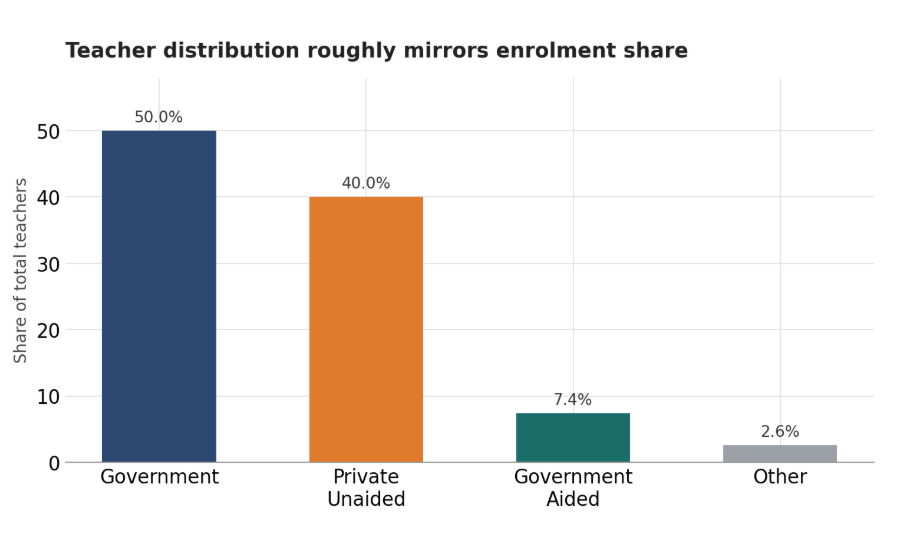
(Source: UDISE+ 2025-26, Table 1 and Chart 2.3.4. Figures represent the 2025-26 reporting period and are not live data.)
Of India’s 1,02,73,020 teachers, government schools employ 51,34,623 (50%), private unaided schools employ 41,07,232 (40%), government-aided schools employ 7,60,462 (7.4%), and other schools the remainder, per the UDISE+ 2025-26 Booklet. This distribution tracks closely with enrolment share, which is reassuring at the aggregate level, it suggests teacher deployment broadly follows where students are, rather than one sector being dramatically over- or under-staffed relative to the other nationally.
India’s overall Pupil-Teacher Ratio stood at 24:1 in 2025-26, with 10:1 at Foundational level, 12:1 at Preparatory, 17:1 at Middle, and 21:1 at Secondary, all comfortably inside the NEP 2020 target of 30:1. A lower PTR is generally considered favourable, smaller classes can allow more individual attention, but it doesn’t automatically mean better teaching. Teacher qualification, training, experience, and how a school actually uses its staffing all matter as much as the raw ratio, and national PTR figures say nothing about whether a specific school’s teachers are well-trained or well-supported.
Do Students Actually Learn More in One System?
This is where national data offers real insight, and where the direction may surprise people who assume private automatically means better.
The ASER 2024 report found that government schools drove most of the post-pandemic recovery in both reading and arithmetic, improving faster than private schools across most of the grades and skills ASER tracks between 2022 and 2024. This doesn’t mean government schools have overtaken private schools in absolute learning levels, ASER’s data has historically shown private-school students scoring somewhat higher on average reading and arithmetic assessments, but it does mean the recent trend line favours government schools’ rate of improvement.
It’s important not to read either finding as a simple verdict. If private-school students perform better on a given metric, that can reflect the schools themselves, but it can just as easily reflect the students who attend them: private schools generally serve families with higher household income, more parental education, and more resources for support outside school, factors ASER and most learning-outcome researchers flag as significant confounders. A private school in a well-off urban neighbourhood and a private school in a low-income area serving first-generation learners are both “private,” but they don’t face comparable starting conditions, and neither comparison isolates what the school itself contributed versus what the student’s background already provided. Correlation between school type and test scores is not the same as proof that school type caused the difference.
NCERT’s PARAKH Rashtriya Sarvekshan 2024, a separate school-based national assessment covering both government and private schools, offers a complementary data point: national Language proficiency at Grade 3 recovered to 57% in 2024, up from 39% in 2021, a recovery pattern broadly consistent with what ASER found in its own, separately-run household survey. Two different methodologies pointing the same direction is a stronger signal than either alone, even though neither dataset resolves the government-versus-private question definitively.
Does Paying More Mean Better Education?
The honest answer is: it depends, and not in a way that resolves neatly into “private” or “government” as categories.
Private schools may have advantages in areas like smaller average class sizes in some cases, more consistent English-medium instruction, and, in well-resourced schools, more extracurricular and infrastructure investment funded by fees. Government schools may have advantages in areas like the recent pace of learning recovery per ASER 2024, near-universal geographic access, and freedom from the cost pressure that shapes decision-making in fee-dependent private schools.
But both of those are generalisations, and generalisations are exactly what break down at the level of an individual school. A well-run government school with experienced, stable teaching staff can outperform a poorly managed private school charging significant fees, and the reverse is just as true. The data makes clear that “government” and “private” are management categories, not quality guarantees. Individual school quality, the specific teachers, the specific leadership, the specific resources at that specific campus, matters more than which category the school falls into.
Government or Private: Which One Makes More Sense for Your Child?
For a parent trying to decide, the more useful question isn’t “which is better, government school or private school” in the abstract, it’s which is better for this child, in this location, at this budget.
Budget is often the starting constraint: a family that can’t sustain private school fees for 12+ years shouldn’t build a plan around assumptions of future affordability. Location matters because a longer daily commute has real costs to a child’s time and energy, regardless of which school is technically “better” on paper. Curriculum and board (CBSE, ICSE, state board) affect both the learning approach and, later, competitive exam alignment. Class size and the student-teacher environment shape how much individual attention a child actually gets day to day. Facilities matter, but only to the extent they’re actually used for learning, not just present on a brochure. And a school’s actual academic approach, whether it’s rote-heavy or genuinely focused on comprehension and application, often matters more than its category.
The honest framing: government or private is a starting filter, not the final answer. The specific school and how well it fits your specific child’s needs is what actually determines the outcome.
Compare Government and Private Schools on BodhaNow
National data can tell you what’s true across India or across a state. It can’t tell you whether a specific school, three streets from your home, is the right fit for your specific child. That’s the gap BodhaNow is built to close, moving parents from broad assumptions about government versus private to an actual, side-by-side comparison of real schools on the factors that matter: fees, curriculum, facilities, teacher environment, and more.
Find the Right School for Your Child
Explore CBSE, ICSE & IB schools in Bangalore. Check real-time ratings, dynamic GPS coordinates, and complete fee charts instantly.