NEP 2020 and Competency-Based Education: What Is Changing in Indian Classrooms?

NEP 2020 makes a clear promise: move Indian classrooms away from rote memorisation and toward competency-based education, where a student is judged on what they can actually do with what they know, not on how much of it they can repeat on an exam sheet.
This is not a small ask. It touches curriculum, teaching methods, assessment and, most of all, the teachers expected to deliver it. This piece looks at that promise section by section and lines it up against the data on how far it has actually travelled into real classrooms.
What Does Competency-Based Education Mean?
The simplest way to explain the meaning of competency-based education is this: instead of measuring how much content a student has covered, it measures whether a student can apply a skill or concept in a real situation.
In education research, competency in education is sometimes called outcome-based, proficiency-based or mastery-based learning, because all four terms describe the same underlying idea: a student progresses once they can demonstrate a skill, not once a set number of weeks has passed. (ICSL, NCF 2023 characteristics of competency-based education).
Core Elements of Competency-Based Learning
- A clear, specific skill or outcome the student is working toward, not just a chapter to finish.
- Progress measured by demonstrated mastery, not by seat time or age.
- Flexible pacing, so faster and slower learners are not held to the same calendar.
- Application to real situations, not just recall in a test.
- Continuous, formative feedback rather than a single high-stakes exam.
This framework is exactly what NEP 2020 and the National Curriculum Framework for School Education (NCF-SE) 2023 are trying to build into Indian classrooms.
Is NEP Implemented Fully? A Timeline Check
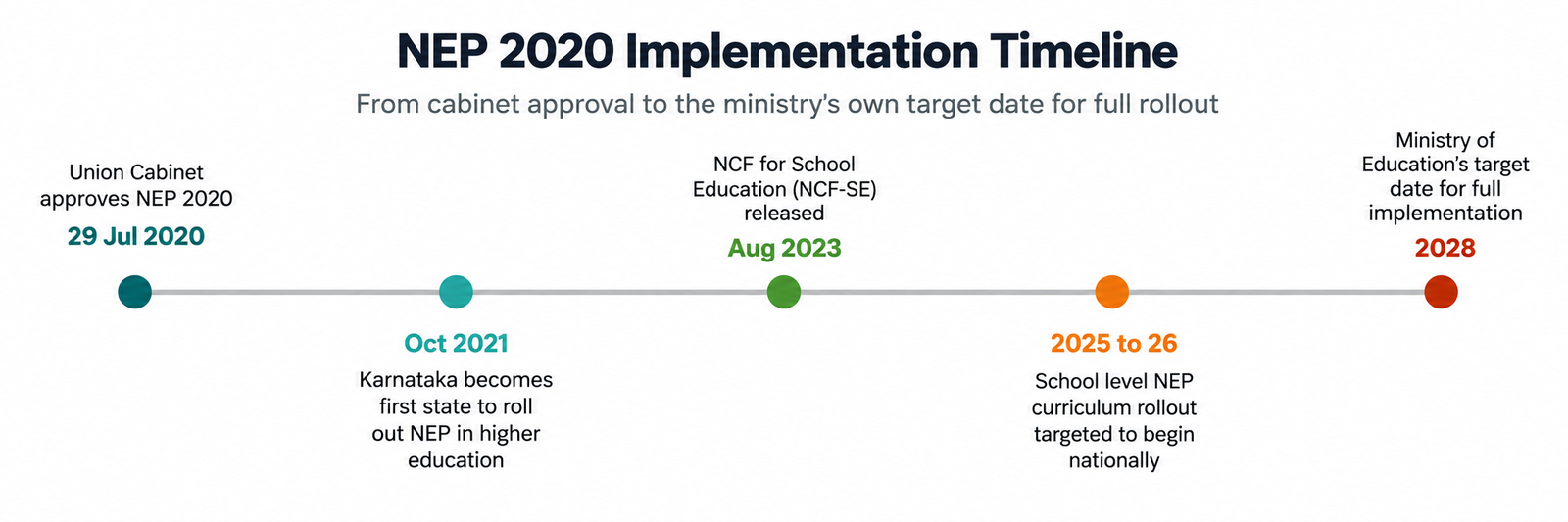
(Source: PIB, Careers360, and reporting on NEP 2020 rollout dates cited above and below.)
Source: PIB, Careers360, and reporting on NEP 2020 rollout dates cited above and below.
According to a report that draws on state government statements, school-level NEP 2020 implementation was targeted to begin nationally from the 2025 to 26 academic year, with the Ministry of Education working toward full implementation across all levels by 2028 (Target Publications, three phases of NEP implementation).
So the honest answer to whether NEP is fully implemented today is not yet, and by the government’s own timeline, it will not be fully in place for several more years.
NEP 2020 Education System: Competency-Based Curriculum and Competency-Based Teaching
The NEP 2020 education system replaces the old 10+2 structure with a 5+3+3+4 model built around how children actually develop.
The curriculum built on top of that structure, NCF-SE 2023, was released by the Ministry of Education under the guidance of the Kasturirangan Steering Committee, and it explicitly moves schools from content-heavy textbook teaching toward competency-based curriculum design, positioning teachers as facilitators of learning rather than deliverers of information (PIB, NCF-SE release; Extramarks, NCF 2023 guide).
What Changes in the Classroom?
In practice, NEP 2020 asks teachers to move towards more interactive, student-centred lessons, reduce the sheer volume of content in each grade, and give students more room for hands-on, exploratory work instead of straight lecturing. These changes are reflected in the teaching methods and pedagogy outlined through the policy and NCF-SE 2023.
NCF-SE 2023 also emphasises structured professional development so that teachers are equipped to teach this way, rather than simply being given new textbooks and expected to adapt on their own.
Experiential Learning Under NEP 2020: Policy Versus Practice
Alongside competency-based education, experiential learning is one of NCF-SE 2023’s central themes. Instead of learning a concept purely from a textbook, students are meant to encounter it through activity, exploration, and direct experience, then connect it back to the underlying idea.
NEP 2020 experiential learning is also tied to vocational exposure, which NEP 2020 wants introduced from Class 6 onward, so that skill building sits alongside academic subjects rather than after them.
Competency-Based Learning Examples in Real Classrooms
- A science class builds a simple water filter instead of only reading about filtration.
- A maths lesson uses a school canteen budget to teach percentages and profit.
- A language class assesses students on summarising a real news article rather than reciting grammar rules.
- A social science project involves mapping a local water source instead of memorising a textbook diagram.
These are the kinds of tasks NCF-SE 2023 is designed to encourage. Whether a given classroom actually runs lessons like this still depends heavily on teacher training and school resources, which is the theme the rest of this piece returns to.
These are the kinds of tasks NCF-SE 2023 is designed to encourage. Whether a given classroom actually runs lessons like this still depends heavily on teacher training and school resources, which is the theme the rest of this piece returns to.
These are the kinds of tasks NCF-SE 2023 is designed to encourage. Whether a given classroom actually runs lessons like this still depends heavily on teacher training and school resources, which is the theme the rest of this piece returns to.
Competency-Based Assessment: What NEP 2020 Assessment Reforms Actually Change
On paper, NEP 2020 assessment reforms are ambitious. Competency-based assessment is meant to replace a single high-stakes exam with continuous, formative checks, and NCERT’s PARAKH body has designed holistic report cards that include peer and self-assessment alongside teacher grading.
Board exams for Class 10 and 12 are meant to move to at least two sittings a year, with students keeping their best score.
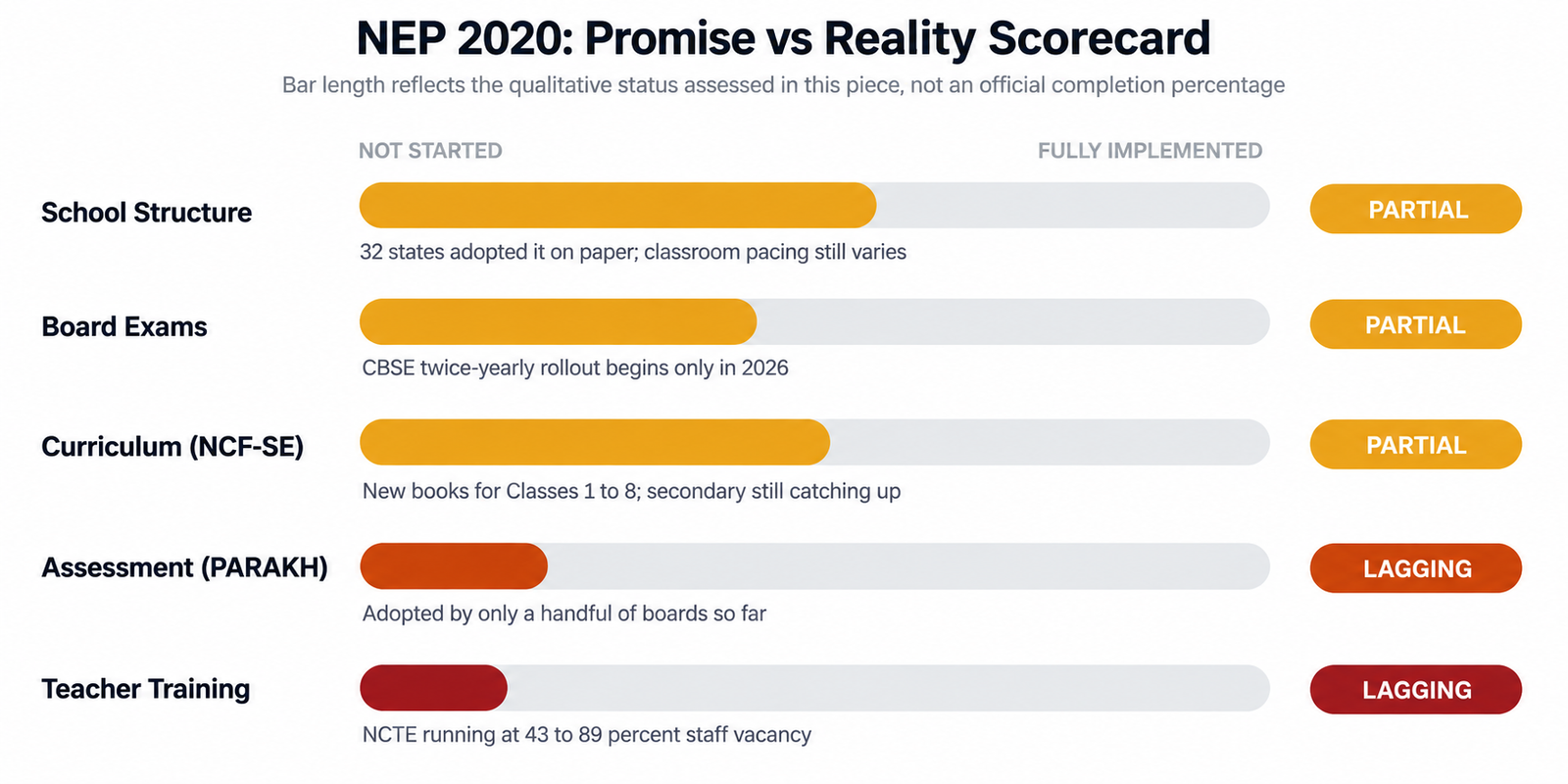
The rollout has been slower than the policy language suggests. CBSE, the country’s largest board, only begins its twice-yearly Class 10 exam from 2026, and PARAKH-style report cards have been adopted by a small number of boards so far.
A related NEP 2020 assessment idea, offering subjects at two difficulty levels, has so far only reached one subject nationally: CBSE Class 10 mathematics, in place from 2019 to 20.
Holistic Education and Skill-Based Education in NEP 2020
NEP 2020’s vision of holistic education is built into NCF-SE 2023 through the Panchakosha Vikas framework, a five-domain model covering physical development, socio-emotional and ethical growth, cognitive skills, language and literacy, and aesthetic and cultural development. The aim is that a student’s report card should reflect all five, not just academic marks.
This links directly to skill-based education, where NEP 2020 wants at least half of all learners to be exposed to vocational or skill training by the time they leave school, starting as early as Class 6. It is a genuine break from treating vocational training as a lower-status track, though the honest caveat is that most available reporting describes this as a target being built toward, not a milestone that has already been reached nationwide.
NEP Teacher Training: Why NEP Training for Teachers Is the Missing Link
Every reform above, competency-based curriculum, experiential learning, holistic assessment, depends on one thing: teachers trained to deliver it.
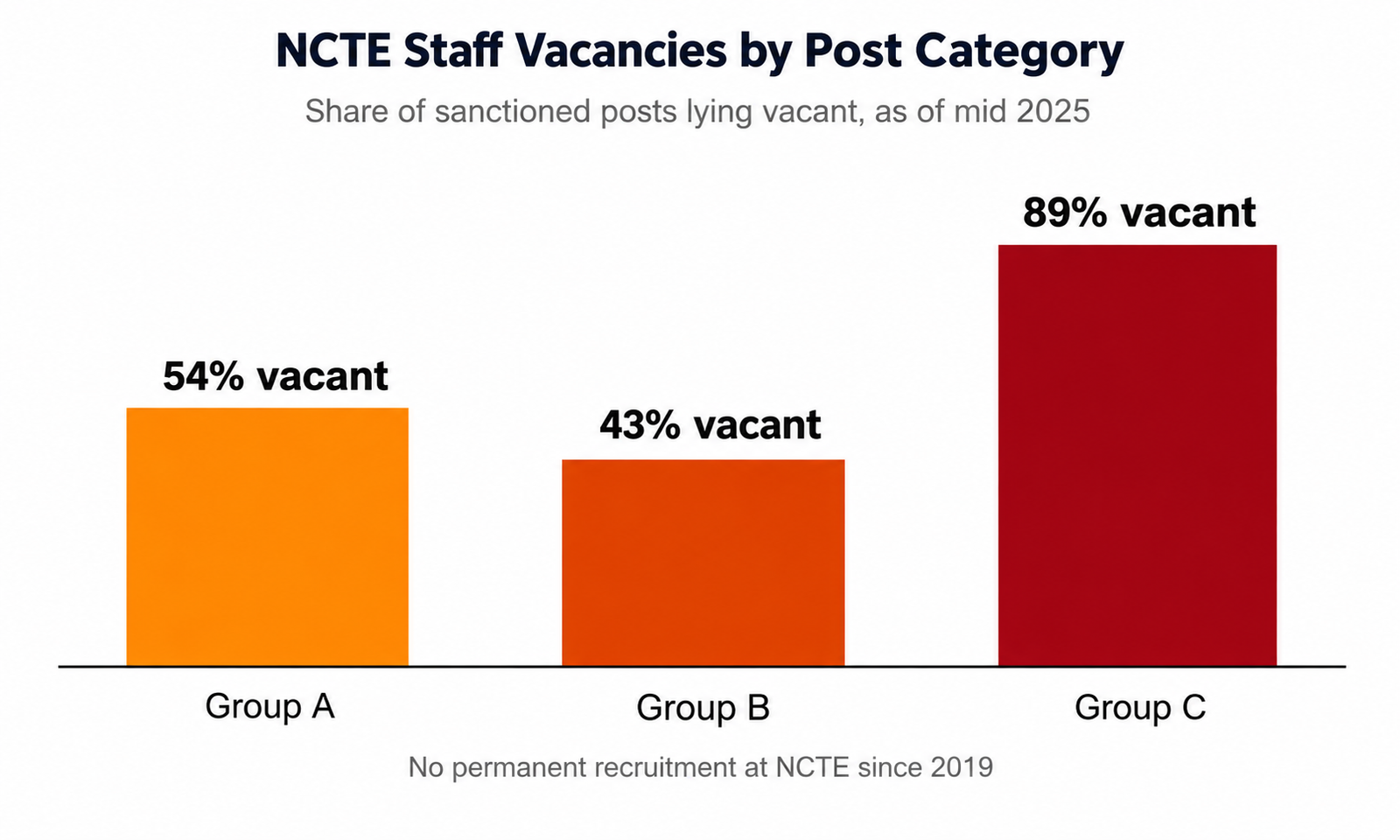
This is where NEP 2020’s implementation is weakest, and the numbers are stark. As of mid 2025, India had around 10 lakh vacant school teacher posts nationwide, with roughly 7.5 lakh of those at the elementary level, according to a Parliamentary Standing Committee report that went as far as to flag NEP’s teacher training design as difficult to make workable given the staffing crisis at its own regulator (Careers360, 10 lakh teacher posts vacant).
Source: Parliamentary Standing Committee Report, via Education for All in India and Careers360, mid 2025 data.
(Source: Parliamentary Standing Committee Report, via Education for All in India and Careers360, mid 2025 data.)
The National Council for Teacher Education, the body responsible for regulating NEP teacher training and NEP training for teachers nationwide, has not carried out permanent recruitment since 2019 and is itself short-staffed across every category of post (Education for All in India, teacher capacity building under NEP 2020).
Kendriya Vidyalayas and Navodaya Vidyalayas, both central government school networks, report teacher vacancies of 30 to 50 percent, and even NCERT, the body that literally wrote the new curriculum framework, had over half its own posts vacant with zero recruitment for two straight years (Careers360, NCERT NCTE NIOS vacancy data).
Source: Education for All in India, teacher capacity building analysis, 2025.
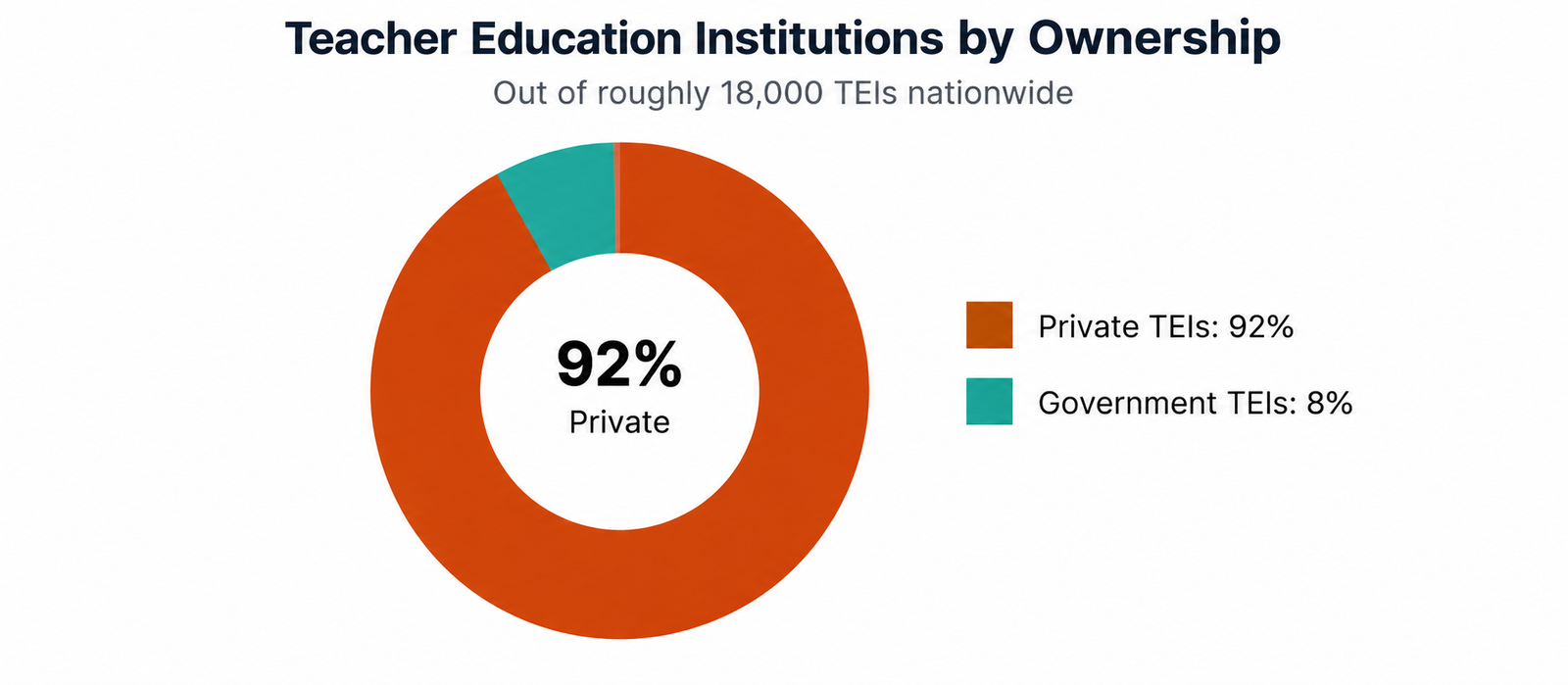
(Source: Education for All in India, TEI ownership data.)
There is a second layer to this problem. Ninety-two percent of the roughly 16,000 Teacher Education Institutions that actually train new teachers are privately run, which raises real questions about consistency, oversight and how closely training matches what NEP 2020 is asking classrooms to do (Education for All in India, TEI ownership data).
NEP 2020’s own response, the four-year Integrated Teacher Education Programme (ITEP), the National Professional Standards for Teachers (NPST), and the National Mission for Mentoring, are all real initiatives. What they have not yet solved is the basic staffing gap at the regulator meant to oversee all of them.
NEP 2020 Promise Versus Ground Reality: A Status Check
Putting the sections above side by side gives a clearer picture than any single statistic. Here is where five of NEP 2020’s core reforms actually stand.
NEP 2020 on Language Education
NEP 2020 on language education recommends, wherever possible, teaching in a child’s home language or mother tongue until at least Class 5. This was never framed as a mandate, but it has still become one of NEP’s most contested points, with states such as Tamil Nadu and West Bengal opposing the accompanying three-language formula as a risk of indirect Hindi imposition, which has slowed curriculum rollout in those states.
NEP 2020 Learning Outcomes: What Does the Data Show?
On NEP 2020 learning outcomes, the clearest evidence so far comes from ASER 2024, which found that 23.4 percent of rural Class 3 children could read a Class 2 level text, a meaningful recovery from the pandemic low of 16.3 percent in 2022, driven mostly by government schools (Careers360, ASER 2024 government schools outperform private).
ASER Centre Director Wilima Wadhwa attributed the recovery specifically to NEP 2020’s systemic focus on foundational learning, saying that the improvement was among the largest seen in recent decades (Ideas for India, ASER 2024 analysis). It is one of the few places in this whole review where policy and classroom data clearly point in the same direction.
So, Are Classrooms Ready for Competency-Based Education?
Partly. The curriculum architecture for competency-based education, NCF-SE 2023, the 5+3+3+4 structure, and PARAKH-aligned assessment, is largely built. Foundational learning data shows real, measurable movement in the direction NEP 2020 intended.
What is missing is the workforce to carry all of this into every classroom at once. A policy that depends entirely on well-trained teachers cannot outrun a regulator running at significant staff vacancy levels, or a national teacher shortage running into the lakhs.
The honest read, five-plus years into NEP 2020, is that competency-based education is not a fiction. It is real in classrooms that already had strong teachers, decent resources, and early state adoption. For the rest of the system, it remains a genuine, well-designed goal that the staffing and funding numbers have not yet caught up with.
Get Personalised School Recommendations on BodhaNow
Every child and family has different needs. Instead of searching through hundreds of schools, BodhaNow helps parents discover schools that match their priorities- whether that’s location, budget, curriculum, facilities, or specific learning needs. Compare your options and find schools that make the most sense for your child.
Find the Right School for Your Child
Explore CBSE, ICSE & IB schools in Bangalore. Check real-time ratings, dynamic GPS coordinates, and complete fee charts instantly.