Higher Education Trends in India: What High School Parents Should Know
Not every child who finishes school in India goes on to college, and which children do isn’t random. It’s shaped by where they live, their gender, their caste, and their state, patterns that show up clearly in the numbers once you look past the national average. Higher education in India has expanded significantly over the past decade, but expansion and equal access are not the same thing, and the data makes that distinction hard to ignore.
This piece draws on the All India Survey on Higher Education (AISHE), the Ministry of Education’s annual survey and the primary source of official statistics on the higher education system in India, to answer a fairly direct question: who actually gets to college in India, and who’s still being left out?
The AISHE report remains one of the few sources with genuinely comparable higher education statistics in India, going back over a decade, tracking everything from the Gross Enrolment Ratio India uses to measure participation, to AISHE data on gender, caste, and state-wise access.
How Many Students Are in Higher Education in India?
India’s higher education system now enrols roughly 4.50 crore students, up from 3.42 crore in 2014-15, a 31.5% increase over the decade, according to the Ministry of Education’s July 2026 release of the AISHE 2023-24 report. This is the most detailed higher education statistics in India currently available, and it shows growth hasn’t been even across genders: female enrolment rose 42.2% over the same period, from 1.57 crore to 2.24 crore, outpacing the overall growth rate.
(Source: AISHE 2023-24, Ministry of Education. Figures represent the respective reporting periods and are not live data.)
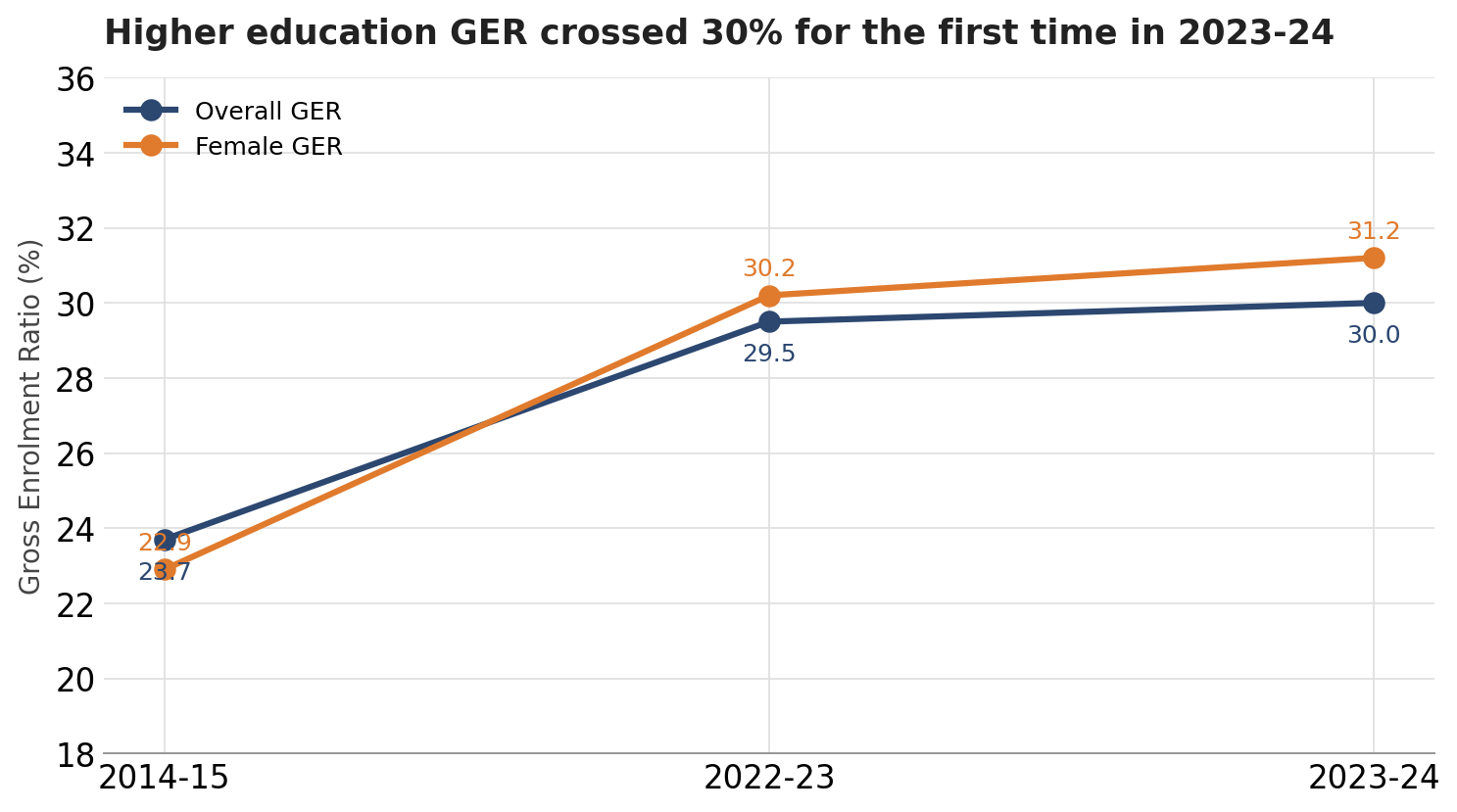
The Gross Enrolment Ratio India uses for higher education, GER for short, is the share of the 18-23 age group actually enrolled in some form of higher education. It crossed 30% for the first time in 2023-24, up from 29.5% the year before and 23.7% a decade earlier.
Female GER now stands at 31.2%, ahead of male GER, and the Gender Parity Index has stayed above 1.0 for seven consecutive years, meaning more women, proportionally, are entering higher education than men. That’s a genuinely significant shift from a system that looked very different a generation ago.
But a 30% GER also means the reverse is true: roughly seven in ten young Indians in the 18-23 age bracket are not enrolled in any form of higher education. This is central to India’s current higher education policy conversation: National Education Policy 2020 has set a target of 50% GER by 2035, which means the current pace of growth, about 0.5 to 1.5 percentage points a year in recent cycles, will need to hold or accelerate for that target to be within reach.
Who Is Being Left Out? Gender, Caste, and Education Inequality in India
The national GER of 30% describes an average, and averages hide the fact that some groups are enrolling at meaningfully lower rates than others.
(Source: AISHE 2023-24, Ministry of Education. Figures represent the respective reporting periods and are not live data.)
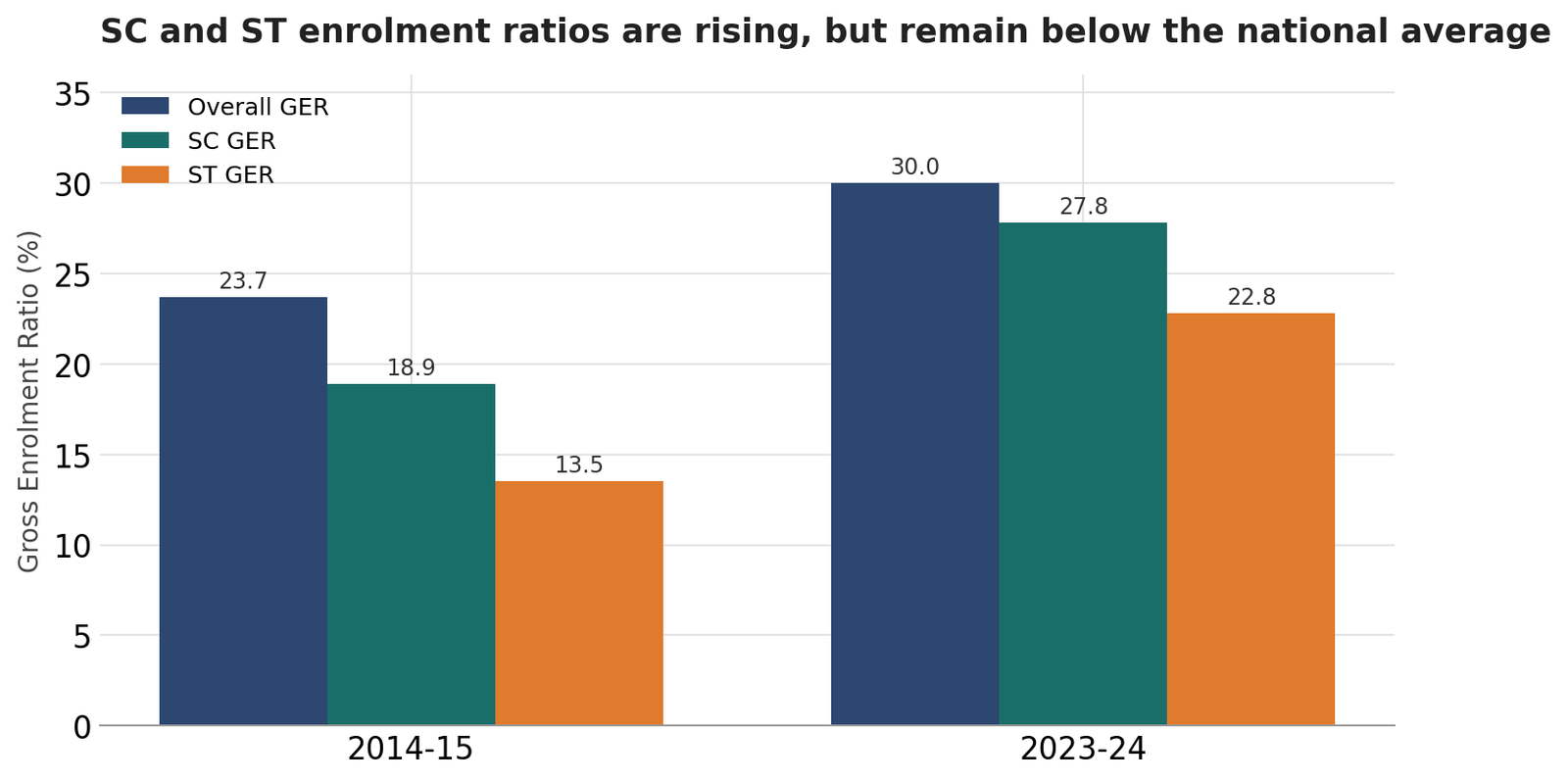
Scheduled Caste (SC) students had a GER of 27.8% in 2023-24, up from 18.9% in 2014-15, and Scheduled Tribe (ST) students recorded a GER of 22.8%, up from 13.5%, per the same AISHE 2023-24 findings. Both figures have improved substantially over the decade, and enrolment numbers have grown even faster than the ratios suggest: SC enrolment rose 51.4% to 69.72 lakh, ST enrolment rose 75.7% to 28.83 lakh, and OBC enrolment rose 60.2% to 1.80 crore. But both SC and ST GER still sit below the national average of 30%, meaning the access gap for these groups, while narrowing, hasn’t closed.
STEM enrolment tells a related but distinct story about gender specifically. Female students now make up 44% of STEM enrolment, up from 38.4% in 2014-15, a meaningful shift in a set of disciplines that has historically skewed male. Total STEM enrolment itself grew from 91.5 lakh to 1.02 crore over the decade.
This is education inequality in India in a fairly literal, measurable sense: not children shut out of the system entirely, but structurally lower odds of reaching higher education depending on the group you’re born into, even as every group’s numbers move upward together. This caste and higher education gap, along with the rural access patterns discussed below, is where higher education inequality in India shows up most clearly in the data.
Which States Have the Highest College Enrollment in India?
National figures also flatten enormous state-to-state variation, and this is where “higher education in India” stops being one system and starts looking like several very different ones operating under the same label. Understanding higher education by state in India means separating two different questions that often get conflated.
(Source: AISHE 2023-24, Ministry of Education, via reporting on the state-wise GER tables. Figures represent the 2023-24 reporting period and are not live data.)
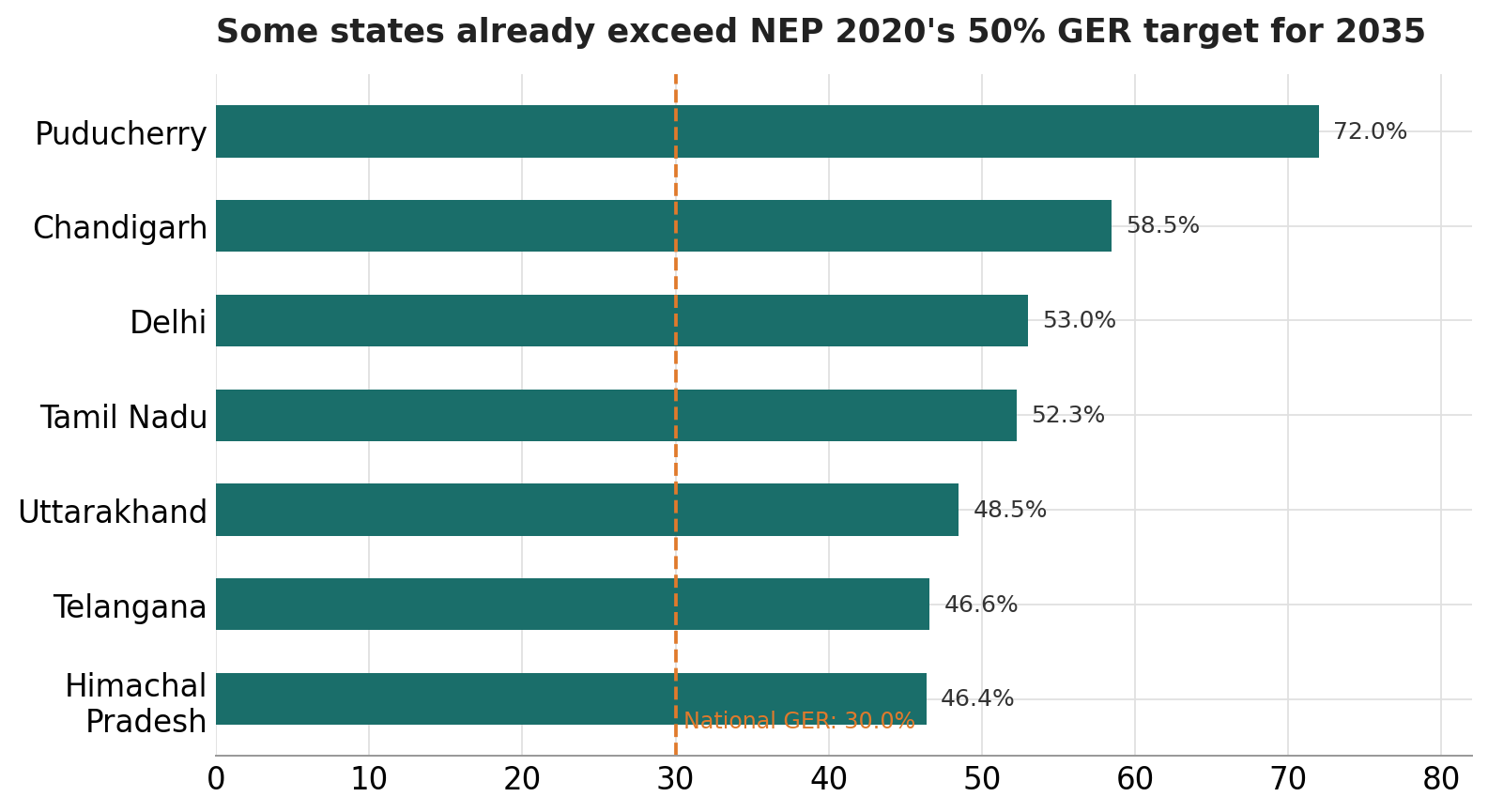
By GER, the proportional measure, Puducherry (72%), Chandigarh (58.5%), Delhi (53%), Tamil Nadu (52.3%), Uttarakhand (48.5%), Telangana (46.6%), and Himachal Pradesh (46.4%) lead the country, several of them already past NEP 2020’s 2035 target of 50%. At the other end, some smaller union territories and less-developed regions record GERs well below the national average.
GER and raw enrollment numbers tell different stories. By sheer enrolment count, Uttar Pradesh leads with roughly 72 lakh students, followed by Maharashtra, Tamil Nadu, Madhya Pradesh, Karnataka, and Bihar, together these six states account for more than half of India’s total higher education enrolment. These are the states with highest college enrollment India has by headcount, but that’s a different list from the states with the highest GER above. Uttar Pradesh has enormous absolute enrollment simply because of its population size, not because a higher share of its eligible population is in college.
This is a genuinely important distinction for anyone trying to answer “which state has the highest higher education enrollment”: the answer depends entirely on whether you mean the proportion of eligible students enrolled, or the total headcount.
Rural Access to Higher Education
Here’s a fact that runs against most assumptions: a majority of India’s colleges, around 60%, are physically located in rural areas, per AISHE data. This complicates a simple urban-rural education gap in India narrative. The access problem for rural students in higher education isn’t primarily about colleges being absent from rural India altogether, it’s about density and distribution. College density, the number of colleges per lakh eligible population, varies from roughly 7 in Bihar to over 50 in states like Karnataka and Telangana, against a national average in the high 20s to low 30s.
A student in a low-density state faces a genuinely different reality, fewer nearby options, longer commutes, or the need to relocate, than a student in a high-density one, regardless of whether a college technically exists somewhere in their state.
Ownership adds another layer. Roughly three-quarters of India’s colleges are privately managed, yet government-run institutions still account for a disproportionately large share of enrolment relative to their numbers, a dynamic that echoes what we found when comparing government and private schools in India at the school level: private institutions often outnumber public ones, but public institutions still carry an outsized share of actual students.
What This Means for India’s Higher Education System
Put together, the AISHE data describes a system that has genuinely expanded, more students, more women, more SC, ST, and OBC students, in raw numbers and proportionally, than a decade ago. That growth is real and worth acknowledging plainly.
But expansion hasn’t erased the underlying access gaps, it’s mostly narrowed them while leaving the basic pattern intact. Gender parity in enrolment has technically been achieved and then some, yet caste-based GER gaps persist, state-level GER varies by a factor of ten between the highest and lowest performers, and rural students face a structurally different set of options depending on which state they happen to live in. These aren’t separate problems, they compound: a rural, lower-income, first-generation college student in a low college-density state is navigating a very different system than an urban student in Delhi or Tamil Nadu, even though both are technically part of the same “higher education in India.”
It’s also worth being careful about causation here. Lower GER in a state doesn’t only reflect a shortage of colleges, it also reflects what happens well before college: school-level dropout and transition rates, and, further back, whether children are reading and learning at grade level and developing the foundational learning skills targeted under NIPUN Bharat in the first place. Higher education access doesn’t start at age 18, it’s the cumulative result of everything that happened in the fifteen years of schooling before it.
A state with weak foundational learning outcomes in Class 3 will likely show weaker higher education participation a decade later, not because colleges are scarce, but because fewer students made it through the pipeline in a position to apply.
Find the Right School for Your Child
Explore CBSE, ICSE & IB schools in Bangalore. Check real-time ratings, dynamic GPS coordinates, and complete fee charts instantly.